PVC is the membrane we specify when a Raleigh commercial roof has to stand up to grease, chemicals, or chronic ponding that would shorten the life of a standard single-ply.
It is a heat-welded thermoplastic like TPO, but the formulation and the seam strength make it the more durable choice for demanding rooftop environments across the Triangle.
Where PVC Earns Its Place on Triangle Roofs
PVC membrane is chemically resistant in a way that matters for restaurants, food processing, and manufacturing buildings where kitchen and process exhaust lands on the roof. Animal fats and many industrial chemicals degrade ordinary membranes; PVC shrugs them off. The hot-air-welded seams are among the strongest in the single-ply category, which is why PVC is also the membrane of choice for low-slope roofs in Raleigh that hold water longer than they should because the structure cannot be re-pitched economically.
How PVC Handles Raleigh Weather and Ponding
The Triangle gets sustained, heavy rain, and not every commercial roof drains the way the original drawings promised. PVC tolerates standing water better than most systems, and its welded seams do not rely on adhesive bonds that ponding can break down over time. The reflective surface also keeps the assembly cooler through the long humid summers, which protects both the membrane and the building's cooling budget.
What We Verify Before a PVC Scope
PVC carries a higher material cost, so the assessment has to justify it. We document the exhaust and chemical exposure, map where water actually ponds, and check whether older PVC on the building has begun to plasticize and turn brittle, which is the system's main age-related failure. The scope identifies whether the right answer is full replacement, a targeted membrane swap in the exposed zones, or a coating on the sound areas.
Heat-Welded Seams, Thickness, and KEE Reinforcement
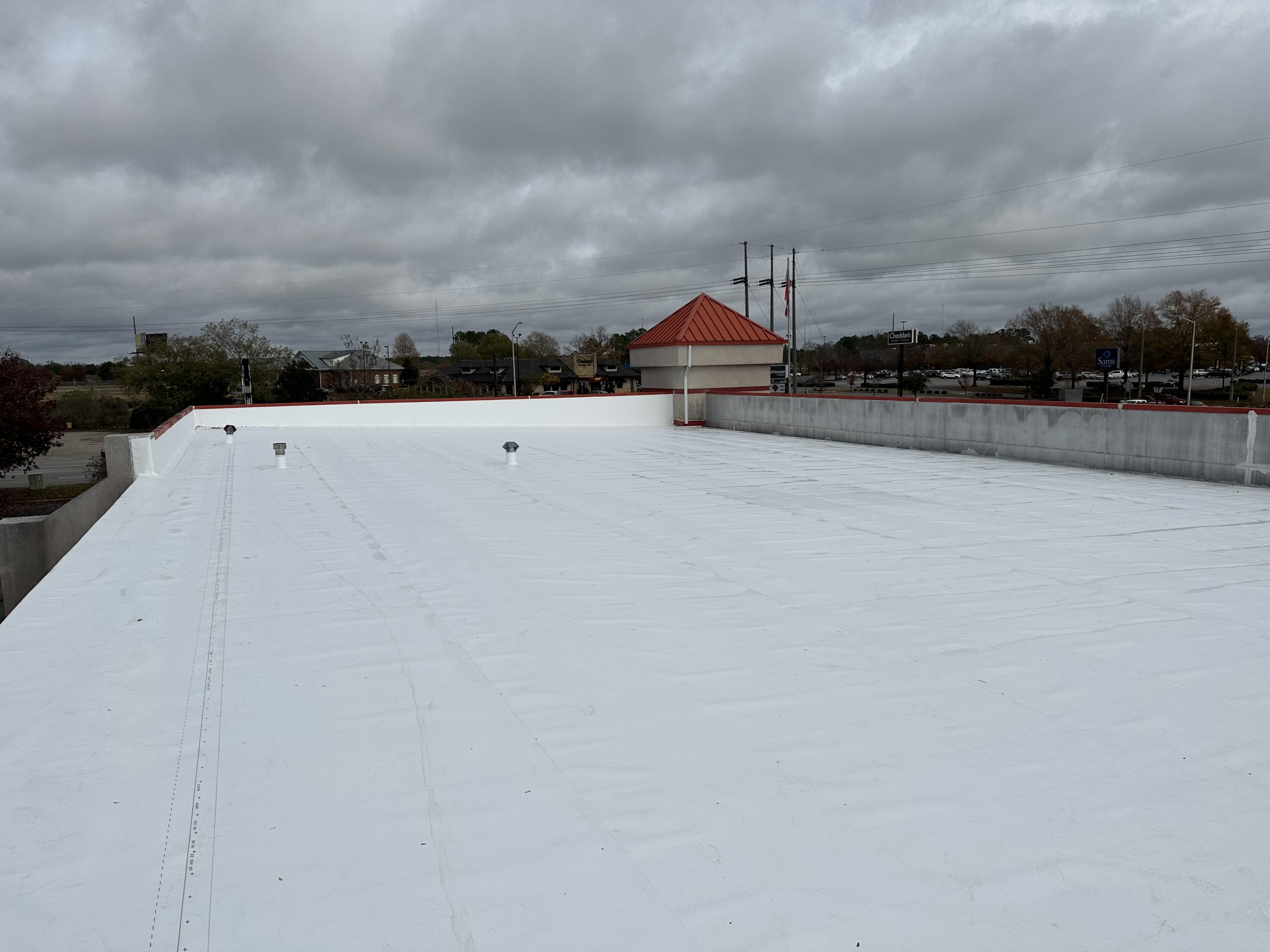
The defining feature of a PVC roof is the seam. Where other systems rely on tapes or adhesives, PVC sheets are fused with hot air into a continuous weld that is as strong as the membrane itself, which is why a properly welded PVC field behaves like one monolithic sheet rather than a patchwork of bonded laps. Every weld we run is probe-tested along its length so a cold or skipped section is caught and repaired before the roof is turned over. That seam integrity is the reason PVC is trusted on the demanding low-slope roofs where water lingers and chemical fallout collects.
Thickness and reinforcement drive how long that performance lasts. We specify 60-mil membrane over 50-mil on roofs with heavy foot traffic, hail exposure, or aggressive chemical contact, because the extra mil thickness above the internal scrim is what resists abrasion and weathering over decades. The polyester reinforcement scrim laminated into the sheet carries the tensile and puncture load. On the most demanding food-service and industrial roofs we move up to KEE-formulated membranes, which lock the plasticizer into the polymer chain so the sheet resists the brittleness that ends the life of ordinary PVC. Matching membrane thickness and chemistry to the actual rooftop conditions is how we set the warranty term we can stand behind.
Triangle Buildings Where PVC Is the Right Call
PVC's grease and chemical resistance lines up with a specific slice of the Triangle's building stock. The restaurant and commercial-kitchen corridors along Glenwood South and around North Hills put animal fat and cooking grease onto the roof every service, and that is exactly the exposure that destroys lesser membranes and leaves PVC intact. Food-processing plants, breweries, and the laboratory and light-manufacturing buildings across Research Triangle Park and NC State's Centennial Campus vent process exhaust that the same chemistry shrugs off.
The pattern repeats through the distribution and industrial buildings strung along the I-40 and I-440 corridors and the warehouses near RDU, where broad low-slope roofs both collect ponding water and host the rooftop equipment that PVC's welded detailing seals around cleanly. Medical and institutional campuses tied to Duke and the region's hospital systems favor PVC where reflectivity, fire performance, and chemical resistance all have to be satisfied at once. When a Raleigh building combines greasy or chemical exhaust with a roof that holds water, PVC is usually the membrane that solves both problems in a single system.
Frequently asked questions
Why choose PVC over TPO for a Raleigh commercial building?
PVC is the stronger choice where grease, chemicals, or persistent ponding are present. For a standard office or retail roof without those exposures, TPO usually delivers comparable performance at a lower cost.
Does PVC become brittle as it ages?
Older PVC can lose plasticizer and stiffen, especially on roofs that ran hot for decades. We core and flex-test the membrane during assessment so a brittle field is caught before it cracks at the seams.
Is PVC a good option for a roof that ponds water?
Yes. PVC's welded seams and ponding tolerance make it one of the better membranes for low-slope Triangle roofs that cannot be economically re-pitched to drain faster.