Spring hail seasons across the Raleigh-Durham Triangle produce hail events that damage commercial roofing membranes, insulation boards, and HVAC equipment on flat roofs. We assess the damage, map the impact pattern, and produce the documentation your insurance claim requires.
Raleigh's spring severe weather season - roughly March through May - brings periodic hail events that range from sub-inch nuisance hail to two-inch-plus stones that cause immediate, visible membrane damage. Wake County has experienced multiple significant hail events in the past decade. The March and April months are the most active, corresponding with the clash of Gulf moisture and cold air masses that generates supercell thunderstorms tracking northeast across the Piedmont.
Hail damage on commercial flat roofs is different from hail damage on commercial shingle roofs - and adjusters who primarily see commercial claims sometimes apply the wrong damage standard. The test for functional damage on a low-slope membrane is not the same as the test for a dimpled asphalt shingle. On a TPO or EPDM flat roof, hail impact damage presents as membrane bruising, insulation board fracture under the membrane, and - on older EPDM systems - impact-driven seam separation at the hail strike location. On metal standing-seam roofs, which are common on retail and industrial buildings in the North Hills and Garner corridors, hail damage presents as dent patterns on the panel flat and rib surface.
Our hail damage assessments are conducted by personnel familiar with the IBC and insurance industry standards for commercial membrane impact damage. We measure impact density across the roof surface, map the pattern to a zone diagram, and distinguish functional damage from cosmetic marking - because that distinction determines what the insurance carrier is obligated to repair or replace.
Spring Hail Season in the Triangle
The Triangle's hail risk is concentrated in spring months and is associated with supercell thunderstorm activity on the southeastern edge of the Appalachian cold-air damming pattern. Wake County sits in the downstream corridor from the I-85 southwest-to-northeast tracking storm path that historically generates the Triangle's most significant hail events. Hail events in the one-inch-plus range typically produce the threshold of damage on commercial membranes that insurance carriers cover; sub-inch events generally produce cosmetic marking on modern TPO without functional damage.
Large-hail events generate claims across a geographic footprint that a single storm track covers. After a significant hail event, we see consistent patterns across a swath of Wake County buildings - buildings in Cary or along the US-1 corridor in one event, buildings in the North Hills / Six Forks corridor in another, buildings in the Garner or Clayton area in a third. The geographic pattern of a hail event, documented by NWS storm reports and radar-derived hail size estimates, is part of the claim documentation.
HVAC equipment on commercial roofs is frequently the most visibly hail-damaged element - condenser fin damage, insulation jacket damage on refrigerant lines, cap sheet damage on curb flashings around equipment. We document rooftop equipment damage as part of the assessment and include it in the scope, because equipment damage is covered under the same commercial property policy as the roof membrane damage.
Hail Damage Assessment Protocol
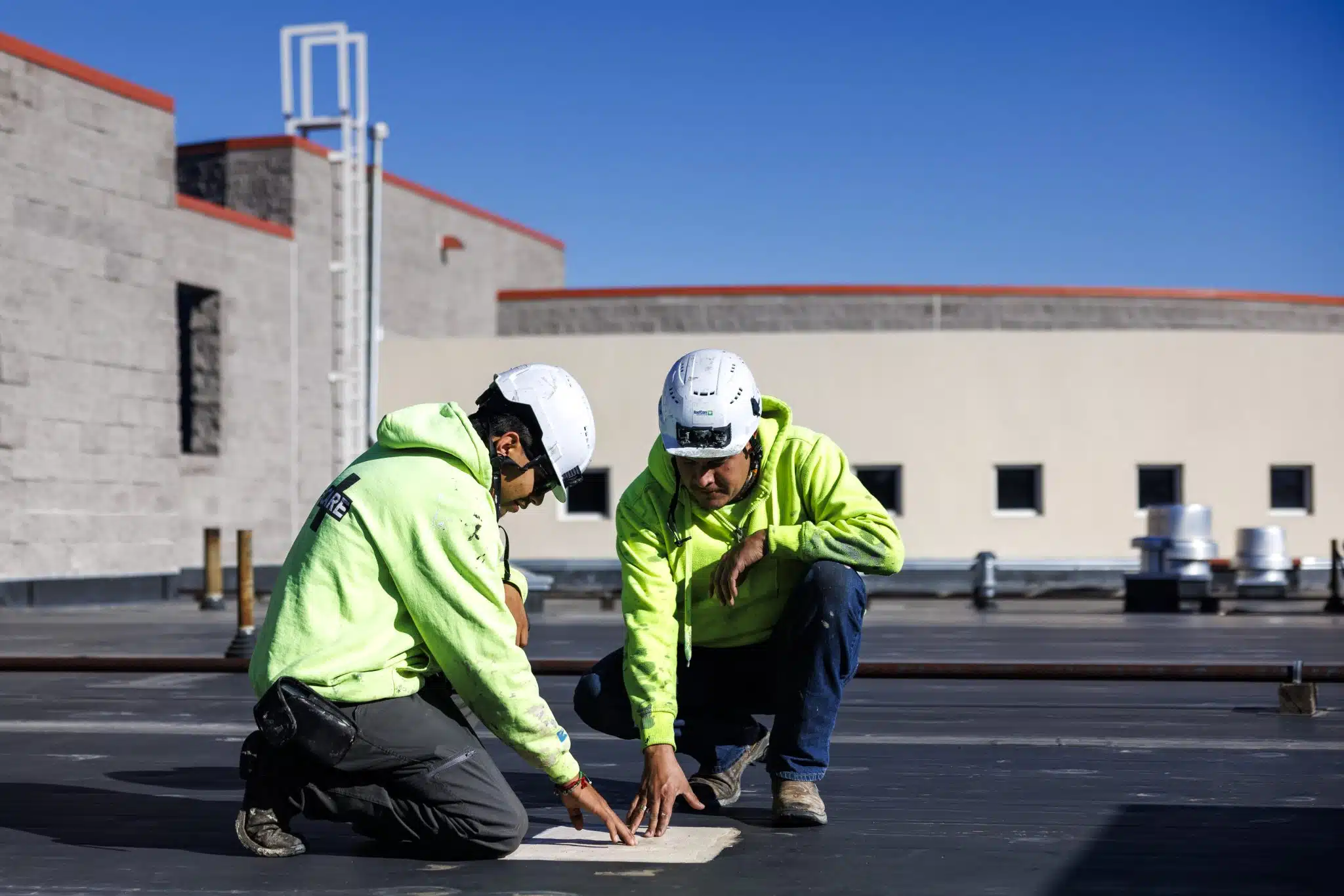
The assessment starts with impact density mapping. We walk a grid pattern across the roof and document impact locations on the zone diagram - recording impact density per 100 square feet, maximum impact diameter, and the presence or absence of membrane fracture or bruising at each zone. A representative sample of impact locations is photographed with a scale reference and identified by zone.
For TPO systems, the functional damage test is membrane fracture or bruising visible after removing surface chalk - not dimpling or surface scuffing, which TPO resists better than older membranes. For EPDM systems, particularly older 45-mil systems from the 1990s and early 2000s that are common on North Hills commercial buildings of that era, impact fracture is the primary damage mode and is more likely at two-inch-plus hail sizes. For modified bitumen and BUR systems, granule loss and membrane blistering at impact points are the primary damage indicators.
Insulation board fracture is confirmed by probing suspect locations - areas with high impact density where the membrane gives under foot traffic in a pattern inconsistent with normal insulation compression. Fractured insulation boards are an insurance-covered repair item on most commercial policies when tied to a documented hail event. This item is frequently missed in superficial post-hail inspections and represents a significant portion of the total repair scope on severely impacted roofs.
Repair Scope and Warranty Implications
Hail damage repair scope on a Raleigh commercial flat roof covers: membrane repair or replacement at zones where impact fracture exceeded functional damage threshold; insulation board replacement at zones where probe testing confirmed fracture; HVAC curb flashing and equipment jacket repair or replacement; and coping and cap sheet repair where hail impact damaged parapet caps. On TPO systems, damaged sections are repaired by welding manufacturer-compatible membrane patches over impact locations.
Manufacturer warranty implications are an important consideration in hail damage repair scoping. Most commercial membrane manufacturers exclude hail damage from their standard material warranties - hail damage is an insurance event, not a material defect. However, the repair work performed to address hail damage must be executed to manufacturer installation specifications if the balance of the warranty is to remain in force. Cutting corners on hail patch work - using incompatible adhesives, skipping test welds, using undersized patches - voids warranty coverage on adjacent areas that were not hail-damaged. We repair to manufacturer spec and document the repair work.
Post-repair documentation includes photographs of each repaired location, test weld results where applicable, and a signed completion statement that your insurance carrier can use to confirm scope completion. If your carrier requires a contractor's sworn statement of repair completion, we provide that as a standard closeout deliverable.
Frequently asked questions
How do I know if my Raleigh commercial roof sustained functional hail damage after a spring storm?
Ground-level observation is not sufficient to evaluate commercial flat roof hail damage. The only reliable method is a documented roof walk with impact density mapping and physical testing at representative locations. If Wake County experienced a hail event with NWS-confirmed one-inch-plus stone size at your building's location, a documented assessment is warranted. Call 919-372-4890 and we will confirm whether the event track and reported hail size puts your building in the affected area.
How long after a hail event does the damage evidence remain visible for documentation purposes?
On modern TPO and EPDM systems, impact evidence is most visible in the weeks immediately following the event, before UV exposure and thermal cycling begin to obscure surface bruising. For insurance claim purposes, an assessment within 30 days of the event produces the strongest documentation. Assessments conducted months later can still identify insulation fracture and structural damage, but surface membrane evidence degrades with time. Prioritize early assessment on buildings you suspect took significant impact.
Do you assess hail damage on metal roofs on Raleigh commercial and industrial buildings?
Yes. Metal standing-seam and metal panel systems on commercial and industrial buildings - common on retail and warehouse buildings along the US-70 corridor, in the Garner industrial parks, and at the RTP industrial edge - present distinct hail damage patterns. We assess and document metal roof hail damage to the same standard as membrane systems, including dent density mapping, rib and seam impact documentation, and HVAC equipment damage assessment.