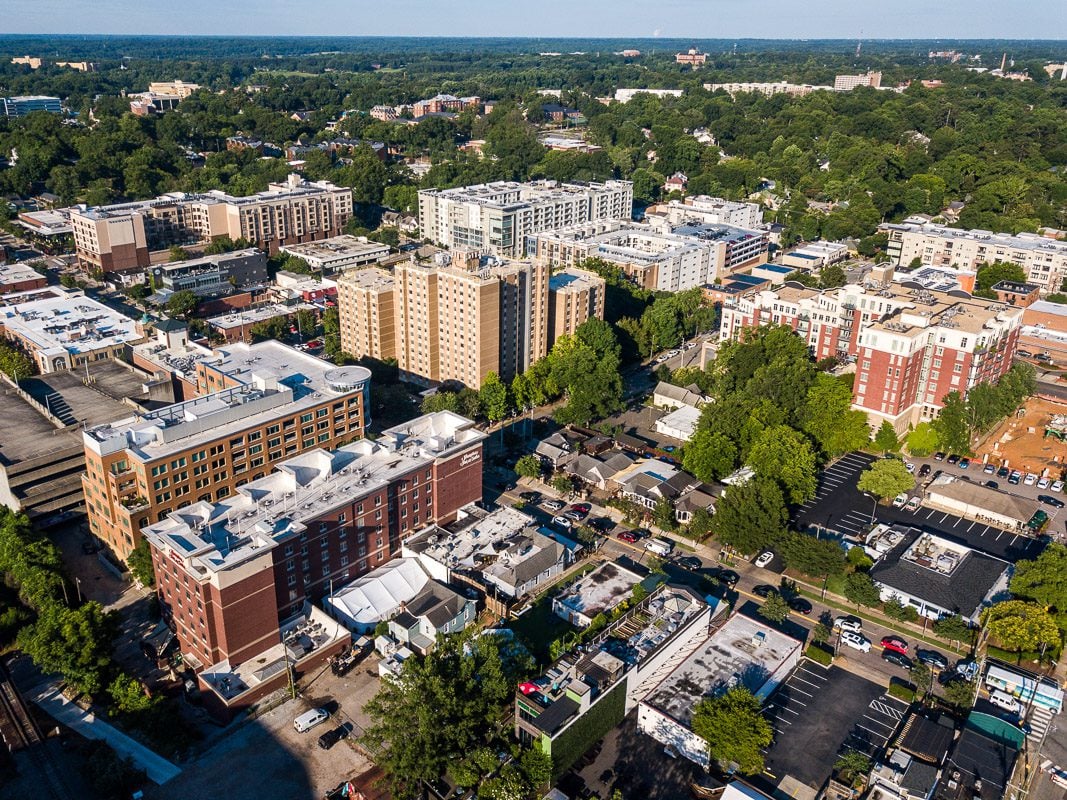
South Raleigh runs from the I-, US-401, and Rock Quarry Road toward the Garner border - a commercial and industrial corridor that serves the south Wake County manufacturing, distribution, and service economy.
South Raleigh is the part of the city that most commercial real estate conversations skip over. It does not have the Class A office towers of North Hills or the headline redevelopment narrative of Downtown. What it has is the industrial and commercial infrastructure that makes the broader Raleigh economy function: manufacturing facilities, distribution centers, food processing operations, auto service and parts supply, and the neighborhood commercial strip development that serves one of the fastest-growing commercial populations in Wake County.
The commercial buildings in South Raleigh are a mix of 1970s and 1980s industrial and commercial construction along the S. Saunders Street and Capital Boulevard South corridors, 1990s and 2000s commercial development along Rock Quarry Road and the Hammond Road commercial zone, and newer logistics and industrial construction along the Garner border near I-40 and US-70. The roofing maintenance picture reflects that age distribution: older buildings with deferred maintenance needs, mid-vintage buildings at the recover-or-replace decision point, and new construction that needs maintenance program setup.
We work throughout South Raleigh on the full range of commercial building types. The South Raleigh community has historically been underserved by commercial real estate maintenance contractors who concentrate their routes in the higher-visibility corridors. We have deliberately built our inspection route network to include South Raleigh because the buildings here have the same roofing risks as buildings anywhere else in Wake County - and in many cases greater urgency, because the deferred maintenance has been deferred longer.
Rock Quarry Road and Hammond Road Commercial Corridor
Rock Quarry Road is South Raleigh's primary east-west commercial spine, running from S. Wilmington Street east toward the Eastern Wake County boundary. The commercial development along this corridor - strip retail, neighborhood grocery anchors, medical offices, and a concentration of warehouse and light industrial buildings east of the US-64 Business interchange - is predominantly 1990s and 2000s construction.
The neighborhood grocery anchors and strip commercial buildings on Rock Quarry Road are community essential services for one of Raleigh's largest commercial zones - the Southeast Raleigh neighborhoods between Rock Quarry Road and Poole Road are dense and growing. A roof failure on a grocery anchor building is not just a maintenance problem; it is a community services problem. We treat these buildings with the same urgency we apply to medical facilities in other corridors.
The warehouse and light industrial buildings east of the US- represent South Raleigh's working industrial base - small manufacturing operations, auto parts and service distributors, food processing and distribution. These buildings carry higher internal humidity, more demanding ventilation penetration conditions, and less consistent maintenance histories than institutional commercial buildings. Inspection findings on these buildings often reveal that roof penetration flashings have been modified by tenants without proper restoration of the waterproofing - a common pattern in tenant-improvement-active industrial buildings.
S. Saunders Street and US-401 Commercial Strips
The S. Saunders Street corridor from the I-440 Beltline south toward the Garner border is one of Raleigh's oldest continuously developed commercial strips - a mix of auto service and parts, neighborhood retail, and the healthcare and social services facilities that serve Southeast Raleigh. Many of the buildings on this corridor date to the 1960s and 1970s, making them among the oldest commercial building stock in Wake County outside the Downtown core.
1960s and 1970s commercial buildings on S. Saunders Street are typically built-up roofing systems - layers of felt and bitumen - that may have been covered by one or more recover systems over the decades. The cumulative weight of multiple recover layers on an aging deck is a structural consideration that needs to be evaluated before adding another recover layer. We assess deck condition and cumulative roof system weight as part of the inspect-before-scope process on these vintage buildings.
The US-401 corridor - Garner Road running southeast from South Raleigh toward Garner - has seen accelerating commercial development as Garner's growth pushes northwest toward the Raleigh boundary. The commercial buildings along US-401 between the city limit and the I-40 interchange are a mix of new construction and older commercial strip development that serves both South Raleigh and the northern Garner commercial growth zones.
Garner Border Industrial and Logistics Zone
The I-40 / US-70 interchange area at the Raleigh-Garner border is one of the Triangle's established industrial and distribution zones - accessible from both I-40 west toward RTP and I-40 east toward the I-95 corridor. The industrial and logistics buildings in this zone are a range of vintages: older distribution facilities from the 1980s and 1990s and newer buildings constructed as the Triangle's logistics infrastructure has expanded through the 2010s and 2020s.
Large-footprint distribution and industrial buildings at the Garner border carry the same wind-uplift specification considerations we apply to comparable buildings near RDU and along the I-540 outer loop - open terrain exposure, large roof surface areas that amplify wind load relative to smaller buildings, and the need for fastener patterns specified against the actual site exposure category rather than generic commercial defaults.
The proximity to the railroad corridor through South Raleigh and Garner means that some industrial buildings in this zone have vibration exposure from rail traffic that affects how we specify and install membrane attachment details. We evaluate vibration exposure during pre-construction site assessment on industrial buildings near active rail corridors.
Frequently asked questions
Do you work on older commercial buildings on S. Saunders Street - 1960s and 1970s construction?
Yes. Older commercial buildings on S. Saunders Street and the surrounding South Raleigh corridors require a thorough assessment of deck condition and cumulative roof system weight before any recover recommendation can be made. We provide that assessment as part of standard inspection scope on vintage buildings.
How do you approach community anchor buildings - grocery stores and neighborhood services - in South Raleigh?
We treat community anchor buildings as operationally sensitive environments. A grocery store cannot close during roofing work. We sequence work so that the building is dry-in secure at end of each production day, schedule HVAC and penetration work for minimum-traffic hours, and communicate daily production plans to store management so they know what to expect each day.
Do you work on the industrial and distribution buildings near the Garner border?
Yes. Large-footprint industrial buildings near the I-40 / US-70 Garner interchange are in our regular service area. Wind-uplift specification for open terrain large-footprint buildings and production sequencing for large industrial footprints are both standard parts of our scope process for these buildings.