Wet insulation under an intact membrane is invisible to a visual inspection and catastrophic to a recover scope. Infrared thermography identifies saturated zones before you commit to a recover or replacement decision.
The most expensive mistake in commercial roofing is recovering a wet roof. When you install a new membrane and insulation stack over existing insulation that is saturated, you seal the moisture in. The trapped moisture degrades the new insulation from below, accelerates deck corrosion if the deck is metal, and voids the new manufacturer warranty - because every major manufacturer requires a dry substrate as a condition of warranty issuance.
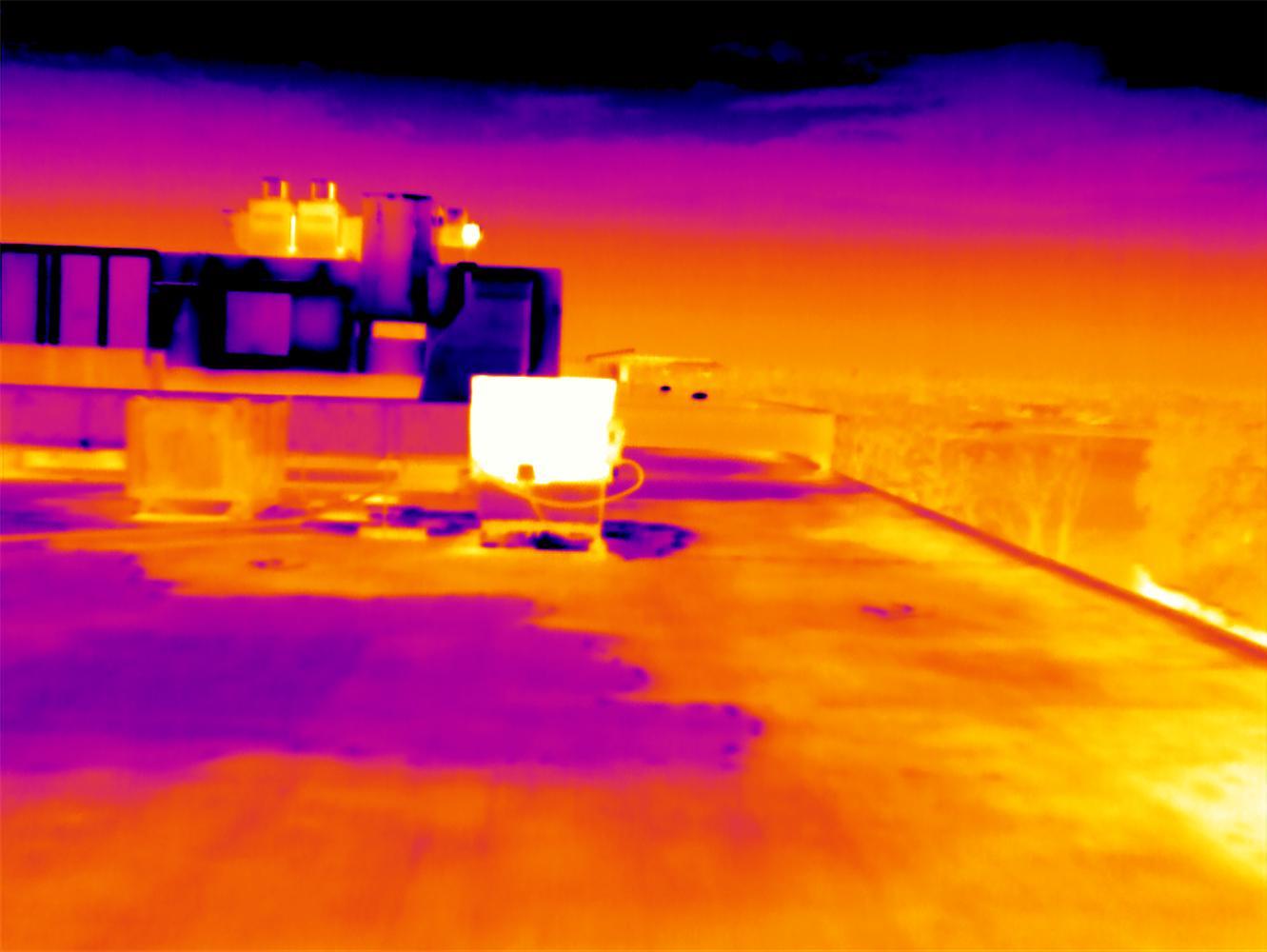
Infrared thermography identifies wet insulation non-destructively, before you cut into anything. The physics are straightforward: wet insulation retains solar heat longer than dry insulation as the roof cools after sunset. Viewed through a calibrated thermal camera during the post-sunset cooling window, wet zones appear as warm anomalies against a cooling background. A properly performed infrared scan on a Raleigh commercial building at dusk, after a dry day with good solar loading, maps the moisture distribution across the entire roof area in a single pass.
We scan in the evening after sunset during the Triangle's spring and fall windows when solar loading is adequate and ambient temperatures allow sufficient thermal contrast. Summer scans are possible but require later-evening timing given the region's slow evening cooling under high humidity. We follow every scan with targeted core pulls at the identified anomaly locations to verify and calibrate the infrared findings - the scan identifies, the core confirms.
Why Infrared Matters Before a Recover Decision
The recover-versus-replace decision is the central question in any aging-roof capital discussion. Recover - installing new membrane and insulation over existing - costs roughly 40-60% less than full tear-off replacement and can extend the asset another 15-20 years when executed correctly. The condition that makes recover wrong is saturated insulation in the existing assembly.
Visual inspection alone cannot locate saturated insulation under an intact membrane. Probing the surface gives no signal. Even core pulls, if randomly located, may miss saturated zones in a large field. A properly performed infrared scan maps the entire roof area and directs core verification to the precise locations where moisture is suspected - so the decision is based on a complete picture of moisture distribution, not a sample.
On Raleigh commercial buildings that have been through Hurricane Florence's 2018 remnant rainfall or Helene's 2024 moisture event, undocumented insulation saturation is a real risk. Roofs with marginally functioning drains or seams that held during normal rainfall may have been overwhelmed during sustained multi-day events - and the insulation absorbed moisture that has never been identified. For any significant recover or replacement decision on a building that was in service during those events, an infrared survey is the minimum responsible step before committing capital.
The Infrared Survey Process
Pre-scan conditions: Effective infrared roofing surveys require three conditions - adequate solar loading during the day to charge the thermal differential, a cooling trend after sunset, and a dry membrane surface for at least 24-48 hours before the scan. We schedule around these conditions; we do not scan after recent rainfall or on overcast days when the thermal contrast is insufficient to produce reliable results. In the Triangle, the September-October and April-May windows tend to produce the most reliable scanning conditions.
Scanning: We scan from the roof surface using a calibrated radiometric thermal camera. The scan covers the full roof area in overlapping passes, documenting the thermal image against a GPS-keyed grid diagram. Anomalies - warm spots consistent with moisture retention - are flagged and marked on the zone map in real time.
Core verification: After the scan, we drill or cut cores at each flagged anomaly location to verify moisture content by direct observation and weight comparison of the insulation sample. Cores are also pulled at several control locations in areas the scan identified as dry, to establish a baseline for comparison. The core results are mapped against the infrared findings, and the two data sets are reconciled in the final report.
Deliverable: The infrared moisture survey report includes the thermal image map, the core location map, core results at each location, a wet/dry percentage estimate for the full roof area, a recover-versus-replace recommendation based on the findings, and a repair scope if targeted wet-area removal is the recommended path.
Applications Beyond Recover Decisions
Infrared scanning is useful beyond the recover decision. It identifies active leak source locations when the interior has experienced water intrusion but the source is unclear from visual inspection alone - the wet insulation around a penetration leak will show as an anomaly even when the surface membrane appears intact. For Downtown Raleigh office buildings with occupied tenant floors below the roof, locating the leak source without a destructive investigation that disrupts tenants is significant.
Annual infrared scans on aging roofs - particularly those approaching the end of their warranty period - create a year-over-year moisture distribution record. If wet areas are growing between scans, the roof is actively taking water at a rate that matters for the capital timeline. If wet areas are stable and confined, targeted insulation replacement at the wet zones during the next maintenance cycle may extend the asset well beyond the standard replacement window.
Institutional clients at NC State Centennial Campus, WakeMed facilities in Wake County, and portfolio owners managing multiple Class A office buildings in North Hills have all used our multi-building infrared programs to prioritize capital allocation across their roof portfolios. The infrared data converts the capital planning conversation from a contractor's opinion to a documented condition record.
Frequently asked questions
Can infrared scanning be performed on any type of commercial roof?
Infrared thermography is most reliable on insulated low-slope and flat roof assemblies - the systems that make up the majority of commercial roofs in the Raleigh market: TPO, EPDM, PVC, modified bitumen, and BUR over polyiso or fiberglass insulation. Metal panel roofs with standing seams present challenges because metal conducts heat in ways that complicate the thermal interpretation. Gravel-ballasted BUR systems are more difficult to scan than exposed membrane systems. We assess the specific roof assembly before scheduling a scan and tell you upfront if infrared is unlikely to produce reliable results for your building.
What percentage of saturated insulation makes replace versus recover the right call?
Most manufacturer warranty guidelines and industry-standard practice treat 25% saturated insulation as the threshold - below 25%, recover with targeted wet-area removal is appropriate; above 25%, tear-off and replacement is the warranted path. In practice, moisture distribution matters as much as percentage: 20% saturation concentrated at drains and penetrations behaves differently than 20% scattered evenly across the field. We report both the percentage and the distribution pattern so the decision is fully informed.
How soon after a rain event should we schedule an infrared scan?
Wait at least 48-72 hours after the most recent rainfall before scheduling. The membrane surface needs to be dry for the thermal differential to reflect insulation moisture rather than surface moisture. If the roof is still wet on the surface, the scan will show the surface moisture pattern, not the insulation moisture pattern - and the two are different. After the surface is dry, the scan conditions depend on solar loading and ambient temperature, which we assess on a schedule-by-schedule basis.