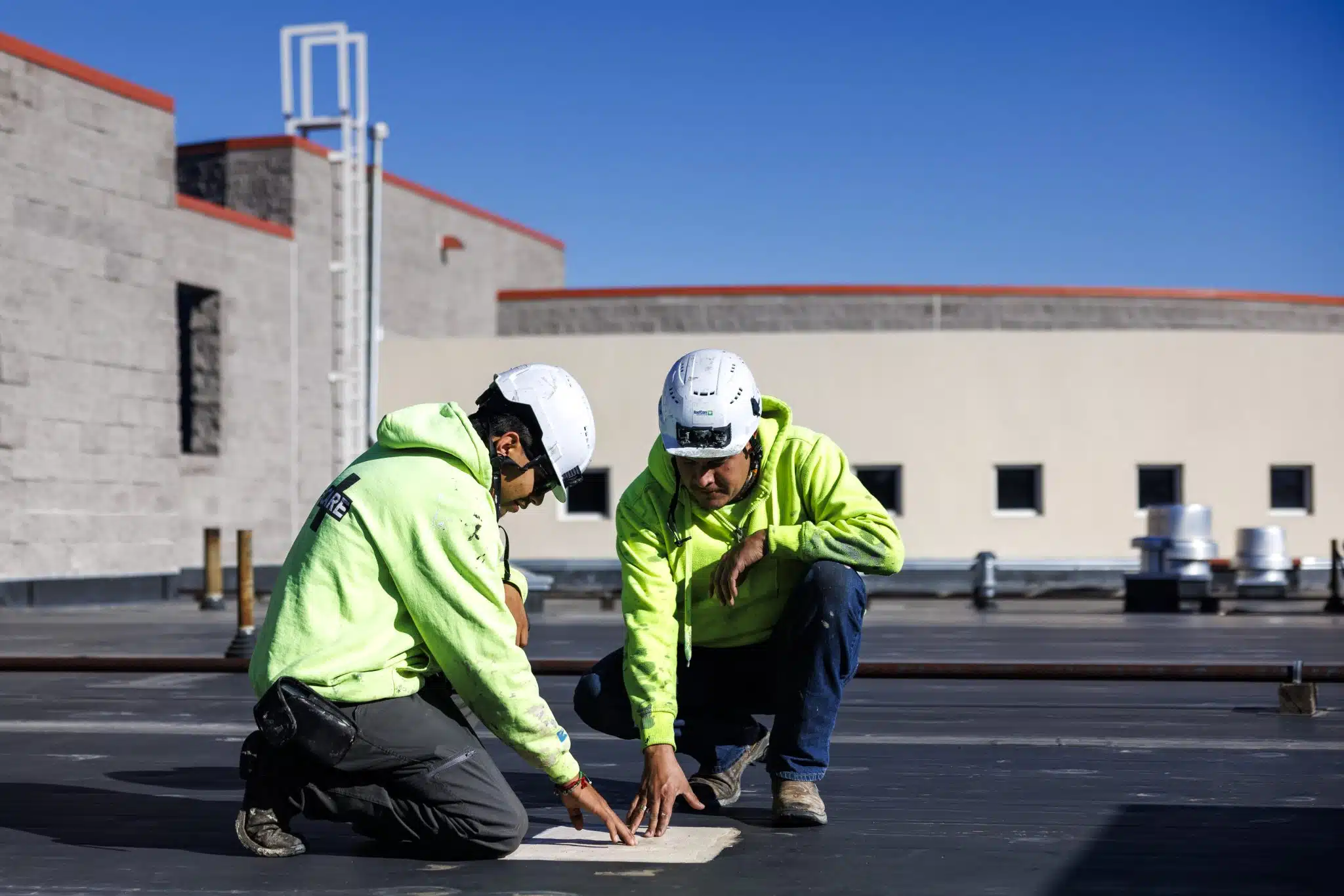
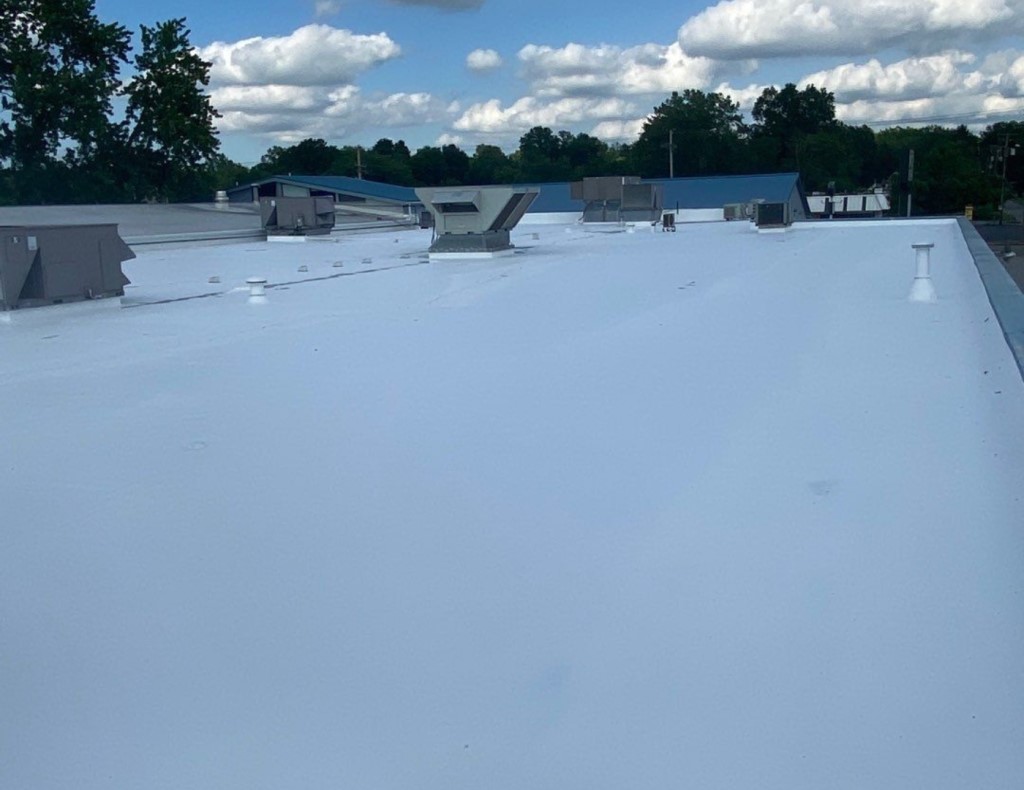
Single-ply membranes are the standard specification for Raleigh commercial flat roofs built or replaced in the last 25 years. We install TPO, EPDM, and PVC across the Triangle - system selection driven by building use, exposure conditions, and warranty requirements, not by what is easiest to install.
Single-ply roofing covers the three dominant modern commercial membrane systems: TPO, EPDM, and PVC. Each uses a different polymer chemistry, each is installed in a single-layer sheet rather than the multi-ply assemblies of BUR and modified bitumen, and each has specific strengths and limitations in the Triangle's climate conditions.
The Raleigh commercial market skews heavily toward TPO for new construction and replacement - it is the most cost-competitive system, carries reliable 20-year NDL warranty terms from most major manufacturers, and its heat-welded seams install well in the Triangle's humid conditions. EPDM remains the preferred specification for industrial buildings with high mechanical traffic and for older campus buildings where the existing membrane was EPDM and the recover path makes sense. PVC carries a cost premium but is the correct specification for buildings with chemical or grease exposure.
Our single-ply installation work covers all three systems across all building types in the Triangle - from the Downtown Raleigh office core to NC State Centennial Campus research buildings to the warehouse and logistics facilities expanding along the I-40 western corridor near RDU Airport. System selection comes out of the scope development conversation, not from a manufacturer preference or a warehouse inventory.
System Selection: The Triangle Climate as the Starting Point
The Triangle's climate is the frame for every single-ply system selection decision we make. Three factors shape the analysis: UV intensity, rainfall events, and thermal cycling.
UV intensity is severe in the Raleigh climate - the Triangle's humid subtropical summers drive rooftop surface temperatures above 160F on dark membranes, and even reflective membranes see 130-140F surface temperatures during July peak. TPO's white reflective surface measurably reduces this thermal load and contributes to measurable cooling cost reductions on commercial buildings across Downtown Raleigh, North Hills, and the US-1 South commercial corridor. EPDM's dark surface absorbs rather than reflects, which can affect cooling costs but does not significantly affect the membrane's UV longevity - EPDM's polymer chemistry is inherently UV-stable.
Rainfall is the second factor. The 2018 Hurricane Florence remnant rainfall and the 2024 Hurricane Helene remnant moisture event both produced multi-day sustained rainfall that stress-tested every roofing system in Wake County. What those events revealed was that seam quality is the determinant of performance under sustained loading - not the polymer chemistry of the membrane field itself. Well-welded TPO and properly bonded EPDM both held under Florence and Helene conditions; poorly installed systems in both membrane categories failed at the seam.
Thermal cycling - the Triangle's full range from January ice storm temperatures below 20F to July surface temperatures above 150F - matters most for EPDM and aged PVC. EPDM is genuinely flexible at low temperatures. Aged PVC becomes brittle. Current-generation TPO maintains flexibility through the Triangle's winter range. We discuss thermal cycling performance explicitly when comparing systems for buildings in the outer Wake County and Johnston County corridors, which see more extreme winter temperature events than the more sheltered urban Raleigh core.
Installation on Research Triangle Park and Institutional Buildings
Research Triangle Park is the single largest concentration of commercial roofing installation and maintenance work in the Triangle. The park hosts IBM, Cisco, GSK, NIEHS, Lenovo, and a growing Apple campus in the southwest quadrant near NC-54 and I-40. Most of these buildings are large-footprint, post-2000 construction with TPO or PVC membrane systems on complex roof geometries with dense rooftop equipment.
Single-ply installation on RTP campus buildings carries access requirements that standard commercial work does not. Vendor pre-clearance, employee background check requirements, campus safety orientation, and coordinated scheduling with campus facilities management are pre-construction tasks on virtually every RTP project. We manage these requirements as standard pre-construction items and have established relationships with the facilities teams at several major RTP campus tenants.
NC State University's Centennial Campus and the broader NC State main campus on Western Boulevard represent the institutional segment of our single-ply work. Centennial Campus in particular - with its mix of university research buildings, private company R&D facilities, and state government labs - has specific procurement requirements for licensed contractors, carries sustainability performance targets that may specify minimum reflectance values for new membrane installations, and requires warranty documentation formatted to the university's facilities asset management system. We deliver to those requirements as standard.
Maintenance and Warranty Compliance for Single-Ply Systems
Single-ply manufacturer warranties - 20-year NDL for TPO and EPDM, up to 25-year NDL for PVC - require documented maintenance to remain in force. Most manufacturers specify at least an annual inspection documenting roof condition and minor repairs, with those repairs completed using manufacturer-compatible materials. Warranties that have lapsed maintenance requirements are voided during the claim review process, which building owners discover at the worst possible time.
Our maintenance program covers the inspection, documentation, and minor repair requirements for all three single-ply system types. We format condition reports to manufacturer warranty compliance specifications and can register reports with manufacturer warranty management systems for clients whose warranty terms require it. For RTP campus and institutional buildings that manage their warranties through centralized facilities management software, we deliver condition reports in the required format as a standard deliverable.
The Hurricane Florence and Hurricane Helene events demonstrated the value of a maintained warranty. Building owners who had documented maintenance programs and warranty-compliant inspection records were in a significantly stronger position when processing storm damage claims than those who had let the maintenance program lapse. The warranty documentation was the difference between a defensible claim and an adjuster's determination that the damage predated the storm event.
Frequently asked questions
Which single-ply membrane is most common on new Raleigh commercial construction?
TPO is the dominant specification on new commercial construction in the Triangle and has been since roughly 2005-2010. Its cost-to-warranty-term ratio is the best in the single-ply category, its reflective surface meets current North Carolina energy code cool-roof requirements on many building types, and its heat-welded seams are field-reliable. EPDM and PVC are specified for the specific applications where their performance advantages justify the trade-offs - industrial and chemical exposure applications, respectively.
Can a single-ply roof be installed over an existing membrane?
Yes, in most cases where moisture core sampling confirms sound insulation. Recover - installing new single-ply over an existing substrate - is appropriate when insulation saturation is less than approximately 25%, the existing surface is stable and provides adequate mechanical engagement for the new attachment method, and the building structure can carry the additional recover weight. Recover costs 40-60% less than full tear-off and carries manufacturer warranty coverage. We pull moisture cores and deck inspections before recommending recover versus replacement.
Do you work with a specific manufacturer, or are you manufacturer-agnostic?
Manufacturer-agnostic on system selection. We install TPO systems from Carlisle, Firestone, GAF, Johns Manville, and Versico. EPDM from Carlisle and Firestone. PVC from Sarnafil and Duro-Last. The right manufacturer for a specific project depends on the warranty terms available for the building's conditions, the technical services support the manufacturer offers in the Triangle market, and the specific system configuration required. We do not have exclusive arrangements with any single manufacturer and will tell you clearly when one manufacturer's warranty terms are more favorable than another's for a specific application.