The roof decides whether your solar array is a good investment
We get brought into rooftop solar projects across Raleigh at every stage, and the ones that go well share a single trait: somebody checked the roof before the racking layout was finalized. The array a developer is selling you is engineered to produce power for a quarter-century. The membrane it bolts to was not necessarily built to last that long, and the moment those two timelines fall out of sync, the math on the whole project changes.
The buildings where commercial PV makes sense in the Triangle are the ones with big, flat, unshaded roofs and real daytime electrical demand. That describes a lot of what sits along the Reedy Creek and Davis Drive sides of Research Triangle Park, the distribution buildings clustered off TW Alexander Drive and the I-540 interchange, and the flex and light-industrial stock around Tryon Road and Garner. Cold-storage operators, contract manufacturers, and the server-heavy buildings in RTP all draw hardest when the sun is up, which is exactly when an array pays. We do not design or sell the solar system. We make sure the roof beneath it carries the load, sheds water around every penetration, and keeps its warranty intact through the install.
Start with how many years the membrane has left
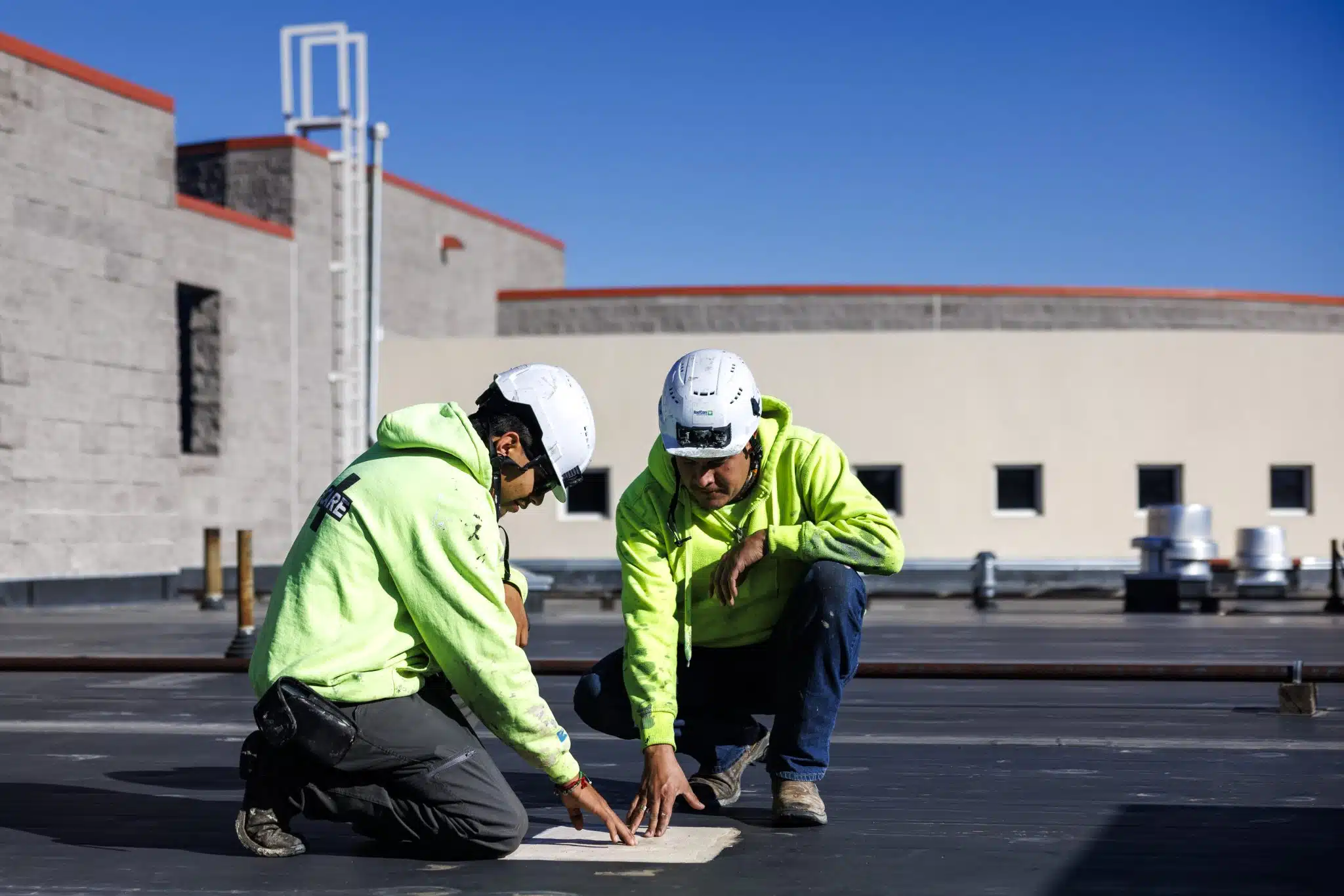
Before anything else, we want a defensible number for remaining service life, and we get it by opening the roof rather than eyeballing it. We pull cores, run a moisture scan, and check the seams and flashings. That number drives the entire decision. A membrane with a dozen-plus solid years ahead of it is a fine foundation for an array. A membrane down to its last handful of years is a trap, because when it fails you are paying a crew to lift every panel and rack off, replace the roof, and set the whole array back down. On a typical Triangle warehouse footprint that detach-and-reset work alone lands in the five-figure range and knocks the system offline for weeks.
So the recommendation writes itself once we have the data. Sound roof: we document the condition and hand the solar contractor a substrate they can build on. Roof near the end: reroof first, then install the array onto a fresh membrane the same season - one mobilization, one clean warranty, no teardown waiting down the road. Raleigh's older inventory leans heavily on aging EPDM and first-generation mechanically attached TPO, so we find roofs on both sides of that line constantly.
Not every membrane belongs under an array
Putting panels over a roof commits that membrane to twenty-five years of shade, foot traffic from O and M crews, and racking components bearing on the sheet. We favor reflective TPO and PVC under solar for concrete reasons. The light-colored surface runs cooler beneath the modules, which helps the panels hold output on hot Carolina afternoons, and both materials heat-weld into a continuous, monolithic seam that handles the standing water solar maintenance inevitably tracks around. Where ballast trays, slip sheets, or walk pads sit directly on the membrane, we verify the sheet is rated for sustained point loading and chemically compatible with whatever it is touching, because certain rubber compounds break down against specific plasticized plastics - a free thing to catch on a submittal and an expensive one to discover as a leak under a live array.
Weight on the structure, uplift on the edges
Most flat Raleigh roofs get ballasted racking, weighted trays that pin the array down without puncturing the membrane. We like that it keeps fasteners out of the field of the roof, but it is not free structurally. A ballasted array adds roughly three to six pounds per square foot across its entire footprint, and that has to square with what the building was originally designed to carry. A lot of the bar-joist warehouses the Triangle put up through the 1980s and 1990s were never sized with that reserve in mind. We raise the structural question before ballast weight gets baked into the layout, and we want an engineer signing off on capacity rather than the team assuming it is fine.
Uplift is the side of the equation people inland tend to underrate. Raleigh sits well off the coast, but it does not escape tropical systems - the soaking, gusty remnants of storms like Florence in 2018 and Helene in 2024 push hard across these rooftops, and an under-secured array is a sail. Wind pressure concentrates at the perimeter and corners of any roof, far above what the broad field sees, and a layout that tiles modules edge to edge as if the whole roof were one uniform zone will start lifting panels and peeling membrane in the first serious blow. We make sure the racking respects those wind zones, setting modules back from the high-pressure edges and confirming the ballast or attachment is calculated for them.
When you have to penetrate, flash it like a roofer would
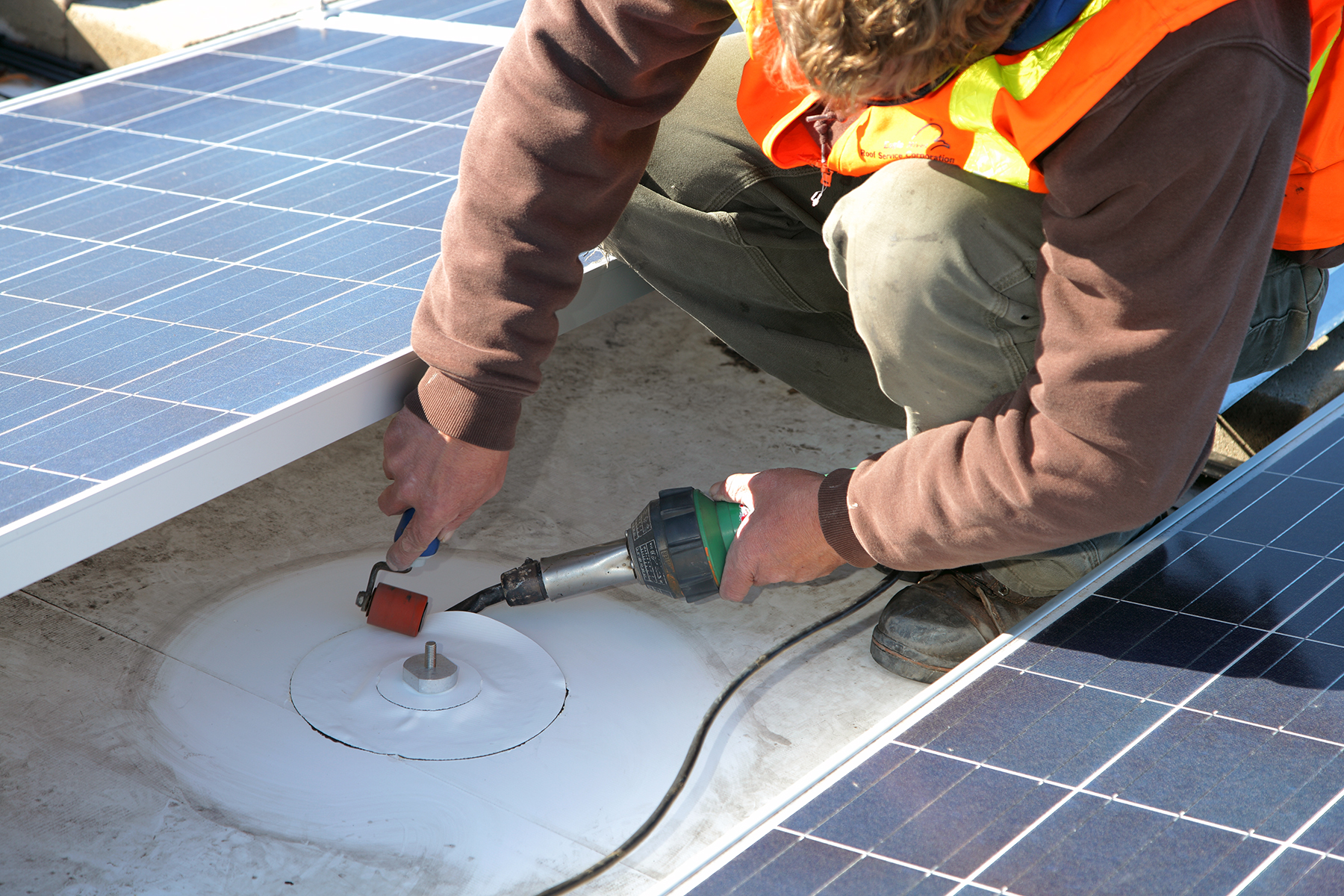
Sloped roofs and flat roofs that cannot carry ballast weight need mechanically attached racking, which means anchors driven through the membrane. Every one of those is a roof penetration, and it gets flashed to the membrane manufacturer's published detail - a properly welded target or a manufacturer boot tied into the field sheet, not a rubber cap and a smear of sealant. The conduit carrying the array's output is the same discipline: it belongs on raised roof supports, never fastened flat where thermal cycling will saw it through the sheet, and it passes inside through a detailed pipe penetration. We have opened enough leaking solar roofs to know the failures almost never begin at the panels - they begin at a conduit run or anchor an electrician flashed instead of a roofer.
Two trades, one watertight roof, one warranty that has to survive
The hardest part of a rooftop solar job is rarely the engineering - it is the seam between the trades. The solar EPC owns the array; we own the roof; and the boundary between them is precisely where leaks and finger-pointing live. We get ahead of it with a pre-construction walkthrough that fixes the sequence in writing: the membrane goes down and gets inspected first, the roofing contractor flashes every penetration and conduit pass-through, and only then do racking and modules land on a roof already proven dry. We also pull the membrane manufacturer's field representative in early, because most major single-ply warranties only cover a rooftop array if the manufacturer reviews the layout, approves the pads and attachment details, and inspects at closeout. Handle that on the front end and coverage holds. Skip it and an owner discovers, years later, that adding solar quietly voided a warranty the roof should still have carried.
Everything we do here protects the asset under the panels for its full life, so when the array eventually needs service the roof is still watertight and still under warranty.
Frequently asked questions
Should we reroof first or put solar on the roof we have?
It depends entirely on remaining service life, which is why we core and scan the roof before anyone decides. With twelve or more documented years left, building on the existing membrane is reasonable. With roughly six or fewer, reroofing first almost always costs less over the life of the array, because you avoid paying to detach the entire system and reinstall it during a future reroof.
Will the array put holes in our roof?
Often not. Ballasted racking holds the array down with weighted trays and never penetrates the membrane. Penetrating anchors only come into play on sloped roofs or where the structure cannot carry ballast weight, and in those cases every anchor is flashed to the membrane manufacturer's detail and stays inside the roof warranty.
How much weight does solar add, and can our building handle it?
A ballasted system typically adds three to six pounds per square foot across the array footprint. Whether the structure can take it depends on the building's original design loads, and many older Triangle warehouses carry thin margins. We flag the structural question before ballast is specified and bring an engineer in to verify capacity instead of assuming it.
Can adding solar void our roof warranty?
Yes, if it is done without the manufacturer in the loop. Most major single-ply warranties allow a rooftop array when the manufacturer reviews and approves the layout, pads, and penetration details and inspects at closeout. We coordinate that review as part of the project so the coverage you already paid for stays intact.
Have the roof checked before the panels are ordered
If a solar proposal is sitting on your desk for a building anywhere from RTP to the Capital Boulevard corridor, let us walk the roof first. We will core it, scan it for moisture, give you an honest service-life estimate, and tell you whether to build on what you have or reroof first - before you commit a twenty-five-year array to a substrate nobody verified.
Explore More
- Government Building Roofing
- Preventive Roof Maintenance
- PVC Roofing
- Skylight Repair
- Capital Planning Support
- Healthcare Facility Roofing
- Roof Asset Management Program
- About
- Commercial Roof Repair
- Commercial Roof Replacement
- Commercial Roof Coatings
- Commercial Roof Inspections & Reports
- Roof Reports & Assessments