Commercial roofing for warehouses, distribution centers, and industrial facilities throughout Raleigh, NC. TPO, EPDM, and metal roof systems.
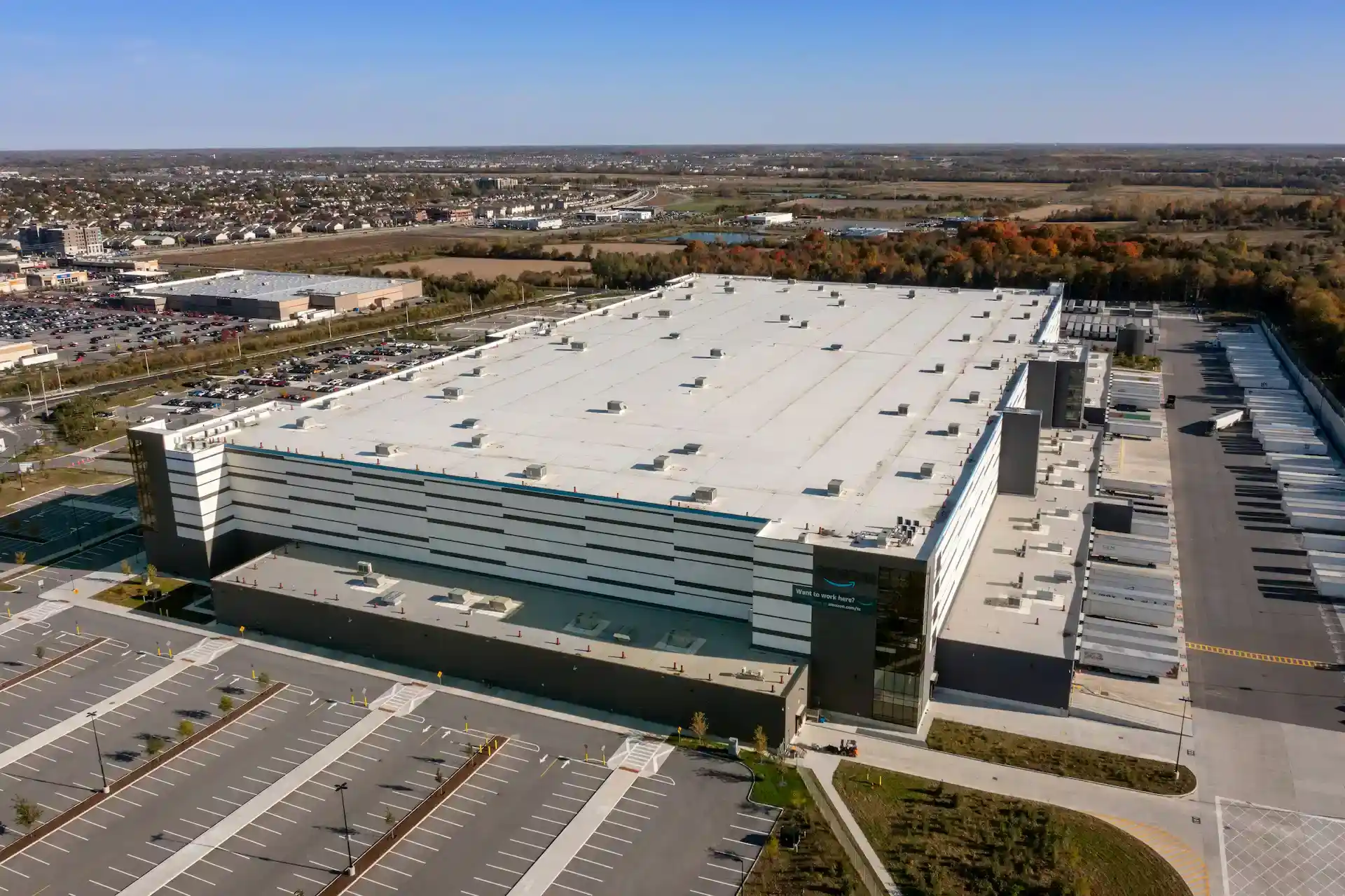
Lowes Foods Distribution Center in Butner, just north of Raleigh in Wake County, is one of the anchor logistics facilities serving the Triangle's rapidly expanding e-commerce and grocery distribution network. Warehouse roofing throughout the Raleigh-Durham-Chapel Hill metro area reflects a climate that sits squarely between the hurricane-exposed Gulf Coast and the freeze-thaw North: enough winter cold for occasional ice storm damage and enough summer heat and humidity to accelerate membrane aging if the wrong system is specified.
TPO has become the dominant membrane for new Raleigh-area warehouse construction over the past decade, driven by North Carolina's statewide energy code requirements and the membrane's lower cost relative to PVC. The North Carolina Energy Conservation Code (based on ASHRAE 90.1, climate zone 3A for Raleigh) requires cool-roof reflectance for low-slope commercial roofs, and white TPO satisfies those requirements while providing excellent performance in the mixed hot-humid climate. A 60-mil mechanically attached TPO system on polyiso insulation achieving R-25 is the standard of care for new industrial buildings in Wake, Durham, and Johnston counties.
Drainage on Raleigh warehouse roofs must handle the region's substantial rainfall - around 46 inches annually - much of which arrives as slow-moving frontal systems rather than the burst events of the Gulf Coast. This means that drains may be flowing continuously for 24-hour periods during winter storms rather than for the 30-minute maximum events typical of Phoenix or Miami. Drain line sizing based on the North Carolina Plumbing Code's rainfall intensity tables for the Raleigh area (approximately 5.2 inches per hour for a 100-year, 1-hour event) will produce proper drain sizing; a contractor who imports drain specs from a project in a lower-intensity rainfall zone will undersize the system for worst-case Raleigh events.
Dock penetration flashing in Raleigh warehouses must handle the region's occasional severe winter ice storms - the Triangle sees two to four meaningful ice accumulation events per decade - which put unusual mechanical loads on counterflashings, pitch pockets, and membrane seams. Metal counterflashings at dock door headers should use two-piece reglets with an open joint sealed with closed-cell backer rod and polyurethane caulk rather than rigid one-piece units, which tend to crack along the sealant joint when ice accumulation adds weight and prying force. EPDM-faced flashing details are more durable than TPO flashing tape at ice-storm-prone locations because they remain flexible at the sub-freezing temperatures that accompany ice events.
Forklift exhaust ventilation is a standard penetration category on any Raleigh distribution center, and the design must account for both summer cooling demands - Raleigh averages 45 days above 90 degrees Fahrenheit - and winter heating. Power exhaust ventilators should be specified with back-draft dampers that close during cold weather to prevent heat loss, and the roof curbs around those units must be insulated to prevent condensation on the interior metal surface during the winter months when North Carolina warehouses run heating systems. Coordinate ventilator placement with the structural engineer to avoid penetrations through primary beam lines or through areas with special uplift restraint requirements.
North Carolina's energy code requires minimum R-25 continuous insulation for low-slope roofs in climate zone 3A. Raleigh is in the moderately demanding range - more than Florida but less than Pennsylvania - meaning that a single layer of 3.5-inch polyiso board typically meets the minimum requirement, though tapered insulation for positive slope may require additional thickness in flat areas. Some large Raleigh logistics developers have begun specifying above-code insulation levels to qualify for utility rebates from Duke Energy Progress or to support LEED Silver certification on speculative buildings, which increases marketability to ESG-focused 3PL tenants.
Wake County and the City of Raleigh both require commercial roofing permits, a licensed North Carolina roofing contractor, and inspections at insulation and final stages. The City of Raleigh's Development Services department has implemented online permitting for commercial projects under $500,000 in contract value; larger projects require a full plan review. North Carolina's contractor licensing board (NCLBGC) requires a general contractor license for projects above $30,000, and roofing subcontractors must be properly licensed or work under the general contractor's license. Verify licensing status at nclbgc.org before contract execution.
Preventive maintenance on a Raleigh warehouse roof should be scheduled in April (before hurricane season) and in October (before the winter storm season). Each inspection should document drain condition, membrane seam integrity, and the condition of all penetration flashings. Post-storm inspections after tropical systems tracking through North Carolina - which deliver significant wind and rainfall to the Triangle despite not making direct landfall on the coast - are advisable after any event producing sustained winds above 50 mph or rainfall above two inches per hour. Budget $0.09 to $0.13 per square foot annually for a well-managed maintenance program.
When soliciting bids for a Raleigh warehouse roofing project, ask each contractor specifically about their experience with ice-storm damage repair and their protocols for protecting open membrane laps during the region's humid summer weather. Lap adhesive that fails to cure properly due to humidity is a leading cause of premature membrane failure in North Carolina; experienced local contractors know the cure window limitations and plan accordingly. References from other Triangle-area logistics operators - particularly those who have made warranty claims and had them honored promptly - are the most reliable indicator of contractor quality in this market.
- What membrane type is standard for new Raleigh warehouse construction?
- White 60-mil TPO is the standard choice, meeting North Carolina energy code cool-roof requirements while providing excellent performance in the Triangle's hot-humid climate. Mechanically attached systems on polyiso insulation achieving R-25 or better are specified on most new industrial buildings in Wake, Durham, and Johnston counties.
- How do Raleigh ice storms affect warehouse roof warranties?
- Ice accumulation on flat roofs creates ponding conditions that can stress membrane seams and flashings beyond normal design loads. Most manufacturer warranties require that drains be maintained in working condition; an ice-blocked drain that causes water infiltration may not be covered as a warranty claim. Document drain maintenance before and after ice storm events to preserve warranty coverage.
- What energy code applies to Raleigh warehouse roofs?
- Raleigh is in ASHRAE 90.1 climate zone 3A, which requires a minimum of R-25 continuous insulation and cool-roof reflectance compliance for low-slope commercial roofs. North Carolina's Energy Conservation Code is adopted and enforced at the local level by Wake County and City of Raleigh Development Services.
- Does Raleigh require hurricane-resistant roofing for inland warehouse buildings?
- Raleigh is not in the coastal high-wind zone, but North Carolina's wind speed map designates the Triangle area in the 115 mph basic wind speed zone. Membrane attachment should be designed for FM 1-75 minimum uplift resistance, and all penetration flashings should be designed for wind-driven rain, which is a consistent risk when tropical systems track through the region.
- How often should a Raleigh warehouse roof be inspected?
- Twice annually - spring (April) and fall (October) - as the minimum, with additional post-storm inspections after any event producing sustained winds above 50 mph or rainfall above two inches per hour. The Triangle's combination of tropical weather risk and winter ice storms creates more potential damage events per year than more climatically homogeneous markets.
Frequently asked questions
Is built-up roofing still installed on new commercial buildings in Raleigh?
Rarely, and effectively not at all for new construction. The hot-mopping logistics, equipment requirements, and fume management make new BUR installation noncompetitive against TPO, modified bitumen, and EPDM for comparable service life. The entire BUR market in the Triangle is assessment, repair, and replacement of the existing inventory - primarily the 1960s through 1980s commercial building stock that predates the single-ply era.
How do I know if my Raleigh building's BUR system needs replacement versus repair?
Core pull data is the only honest answer. A BUR surface that looks marginal may have dry insulation and be a legitimate recover candidate. A surface that looks serviceable may have 40 percent saturation and need full replacement. Visual assessment of BUR by any contractor cannot substitute for core pulls. We pull cores, show you the data, and make a recommendation based on what we find - not based on the project size we want to close.
My building has had multiple BUR patches applied over the years. Does that affect the replacement decision?
Patch history often complicates the recover option more than it affects the replace decision. Repeated patches with incompatible materials - asphalt over coal tar, cold-process over hot BUR - create adhesion problems for any recover system. If the patch history is complex and the new system cannot achieve adequate adhesion to the existing substrate, full tear-off is the only path to a warranted installation. We document patch history during inspection and flag incompatibility risks before any recover scope is proposed.
Do you handle BUR replacement on large industrial buildings along the I-40 and US-1 corridors?
Yes. Large-footprint BUR replacement on industrial buildings in the southwest Wake County and Johnston County markets - buildings of 100,000 to 400,000 square feet - is a significant part of our work. These projects require detailed pre-construction staging plans, sequenced tear-off and daily dry-in to protect active operations below, and sometimes multi-season project scheduling for facilities that cannot absorb a full roof disruption in a single mobilization.