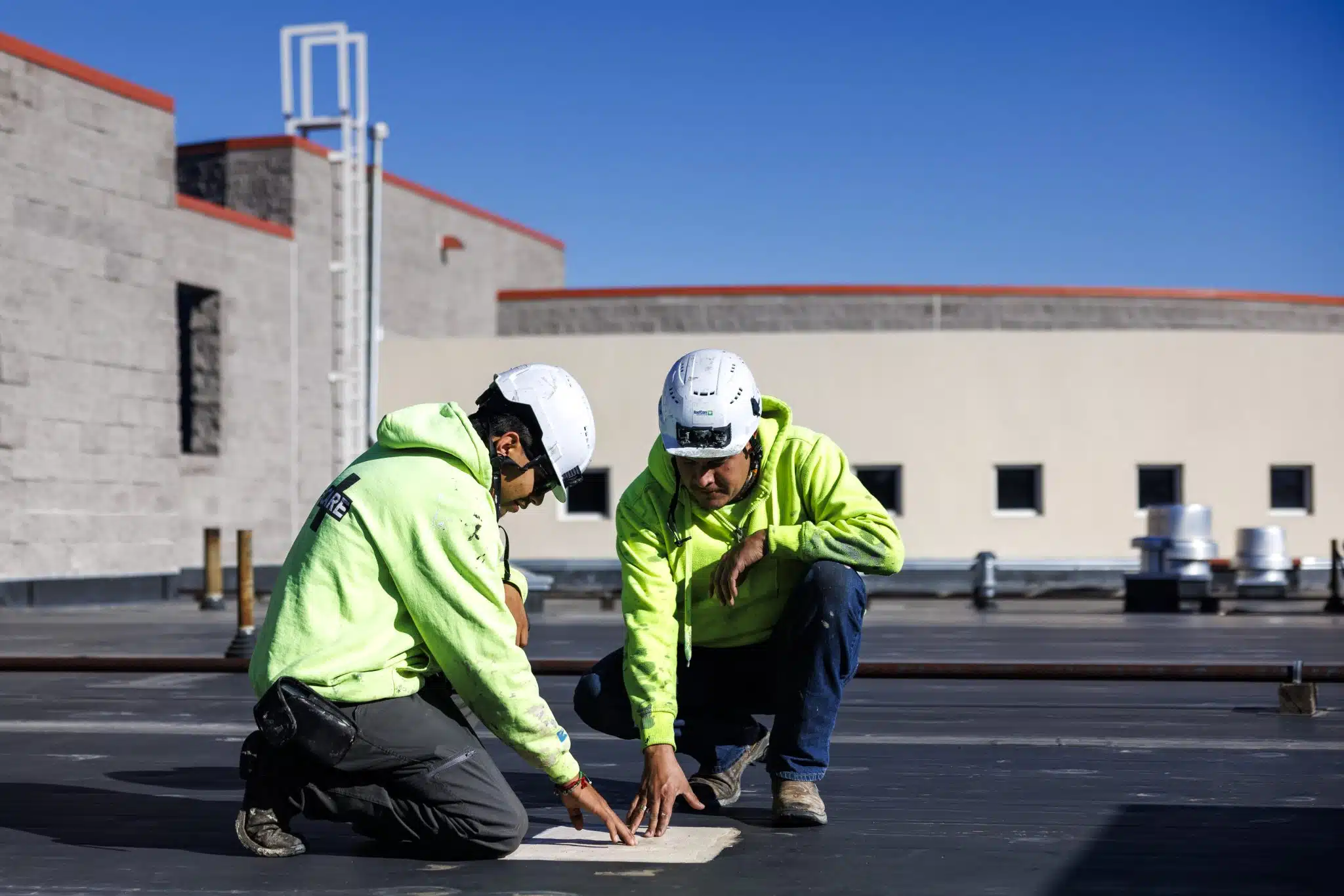
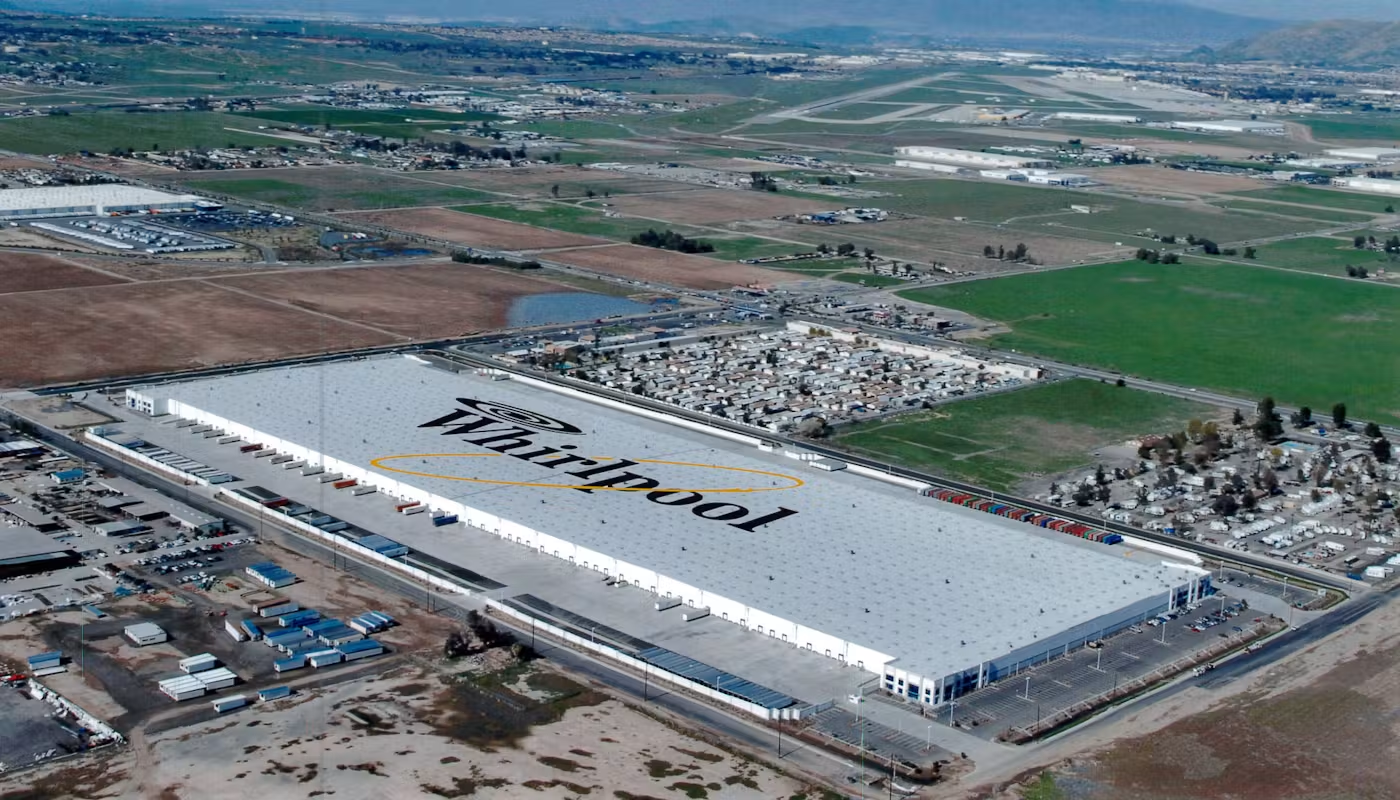
Roof replacement, repair, and maintenance for large-footprint distribution centers along the RDU airport logistics corridor and the Garner/Clayton I-40 industrial band - scoped around continuous logistics operations and the specific roofing challenges of high-bay distribution buildings.
The distribution center development boom that reshaped the Triangle's industrial real estate market through the 2010s and 2020s produced a generation of large-footprint logistics facilities that are now entering the part of their roof system lifecycle where inspection and capital planning decisions matter. The RDU airport corridor - Aviation Parkway in Morrisville, the industrial parcels off Airport Boulevard, and the NC-540 logistics cluster - is the first wave. The Garner and Clayton I-40 corridor, running southeast from Raleigh toward Johnston County, is the second.
Distribution centers have a specific set of roofing challenges that distinguish them from other large commercial buildings. The high-bay interior creates interior condensation conditions that can accelerate insulation degradation from the underside, particularly in climate-controlled facilities. The dock doors and exterior walls on receiving buildings take direct impact loads that can propagate up to the roof-wall interface. The large uninterrupted roof planes - 500,000 square feet is not unusual for a modern distribution center - amplify the consequence of any single drain failure or compromised seam.
We scope distribution center roofing around the facility's operational reality. A fulfillment center running multiple shifts cannot absorb a section closure that takes a receiving dock offline. The production plan for a distribution center roof project is tuned to the dock schedule and the facility's receiving windows, not around the crew's preferred production footprint.
RDU Airport Corridor Distribution Facilities
The aviation parkway and Airport Boulevard logistics cluster in Morrisville and northwest Raleigh sits in the highest-growth industrial real estate zone in Wake County. The proximity to RDU Airport supports both air freight logistics - express carriers, air cargo operators, time-sensitive perishable and electronics freight - and the ground distribution network that uses RDU as a hub for regional coverage across the Carolinas.
Buildings in the airport corridor sit in high-exposure terrain - the open ground plane around RDU produces sustained wind speeds and directional loading that require more conservative fastener pattern specifications than buildings in developed suburban terrain. We design attachment patterns against IBC wind-uplift requirements for the building's specific exposure category, not against a default suburban assumption that may not be appropriate for this terrain band.
Several facilities in the RDU corridor are now in their second generation of roof systems. The original 1990s and early 2000s industrial construction in Morrisville and along the NC-55 corridor has aged into the replacement window. For those buildings, the recover-versus-replace decision depends on moisture core results - and given the prevalence of 45-mil EPDM systems from that era, many are candidates for full tear-off replacement with 60-mil TPO rather than a second recover over aging insulation.
Garner and Clayton - I-40 Corridor Logistics
The I-40 corridor southeast of Raleigh - through Garner and into Johnston County toward Clayton and Smithfield - has absorbed significant distribution center development driven by access to the I-40/I-95 interchange and available industrial land at lower land cost than the RDU corridor. Amazon, FedEx, UPS, and a range of national third-party logistics providers have built or leased facilities in this corridor over the past decade.
Distribution buildings on the Garner/Clayton I-40 corridor are predominantly post-2010 construction with single-ply TPO membrane systems under manufacturer warranty. Many are still within their first warranty period, which means the most relevant roof service they need is documented maintenance that keeps the warranty active, not replacement. We provide manufacturer-compliant maintenance programs for in-warranty distribution center roofs that preserve the NDL warranty at a significantly lower annual cost than the replacement cost for the same building.
For buildings where the warranty has lapsed or the system is approaching end of service life, the replacement scope on a large distribution center requires logistics planning comparable to the building itself. Crane positioning on a 400,000 square foot distribution center is a multi-day logistics exercise. Material staging on a site with active receiving traffic requires coordination with the facility's operations team and, often, the facility's security team.
High-Bay Condensation and Interior Conditions
Distribution centers with temperature-controlled environments - cold storage, pharmaceutical-grade climate control, electronics handling - create interior condensation conditions that can degrade roof system components from the underside at a rate that the membrane's exterior condition does not reveal. An insulation assembly that looks sound from above may have significant moisture accumulation from condensation cycling that is only visible in a moisture core pull or an infrared survey.
We recommend infrared moisture surveys for climate-controlled distribution centers as part of the pre-capital-decision inspection process. An infrared survey conducted from the roof surface in the evening - after the roof has been heating during the day and the interior stays cool - produces a thermal contrast image that makes moisture accumulation in the insulation visible in a way that visual inspection alone does not. That survey is more expensive than a visual-only inspection but produces the information needed to make an accurate recover-versus-replace recommendation.
For unheated distribution buildings with open-air dock sections - a common configuration in basic warehousing and cross-dock facilities along the I-40 corridor - the primary inspection focus shifts to drain performance and seam condition. Large uninterrupted flat roofs with minimal slope to drain are chronic ponding candidates if the drains settle or the field seams develop edge laps that create barriers to water flow. Ponding accelerates membrane degradation and can collapse insulation in severe cases - the January 2022 ice storm demonstrated this on multiple Triangle distribution buildings when ponding water refroze under ice load.
Frequently asked questions
Can you work on a distribution center that is operating multiple shifts?
Yes. Multi-shift logistics facilities are a standard operating condition for distribution center roof work. We develop a production plan that identifies which dock bays and receiving areas are below active production zones during each shift, and we sequence work to avoid overhead production above active dock operations during the facility's peak receiving windows. For facilities with 24-hour operations, we identify off-peak windows - typically the early morning hours between the end of second shift and the start of first shift - for production in sections directly above active operations. All sections are dry-in secured before the next shift begins.
Our distribution center was built in 2003 and the original TPO roof is still under warranty. Do we need to do anything?
A 2003 TPO installation is likely at or past the end of its original manufacturer warranty period, depending on the warranty term. If you have the warranty document, confirm the expiration date and whether the warranty required annual or biennial maintenance inspections to remain active. Many commercial roof warranties lapse because the maintenance inspection requirement was not met - not because the membrane failed. We can perform a condition assessment, confirm warranty status, and if the system has remaining life, develop a maintenance plan that keeps the system performing. If the warranty has lapsed, the assessment will tell us whether recover or replacement is the appropriate next step.
How do you recommend specifying a new roof system for a climate-controlled distribution center in the I-40 corridor?
For a climate-controlled distribution center, the insulation assembly specification matters as much as the membrane choice. The vapor retarder layer - its placement in the insulation stack relative to the dew point - is critical to preventing the condensation-driven insulation degradation that affects climate-controlled buildings. We specify the vapor retarder location based on the building's interior design conditions and the exterior climate data for the specific site. The membrane specification for most I-40 corridor distribution centers is 60-mil mechanically attached TPO with a 20-year NDL warranty. For facilities with high-chemical exposure in the loading dock area or with significant rooftop exhaust from climate systems, we assess the specific conditions before recommending membrane type.