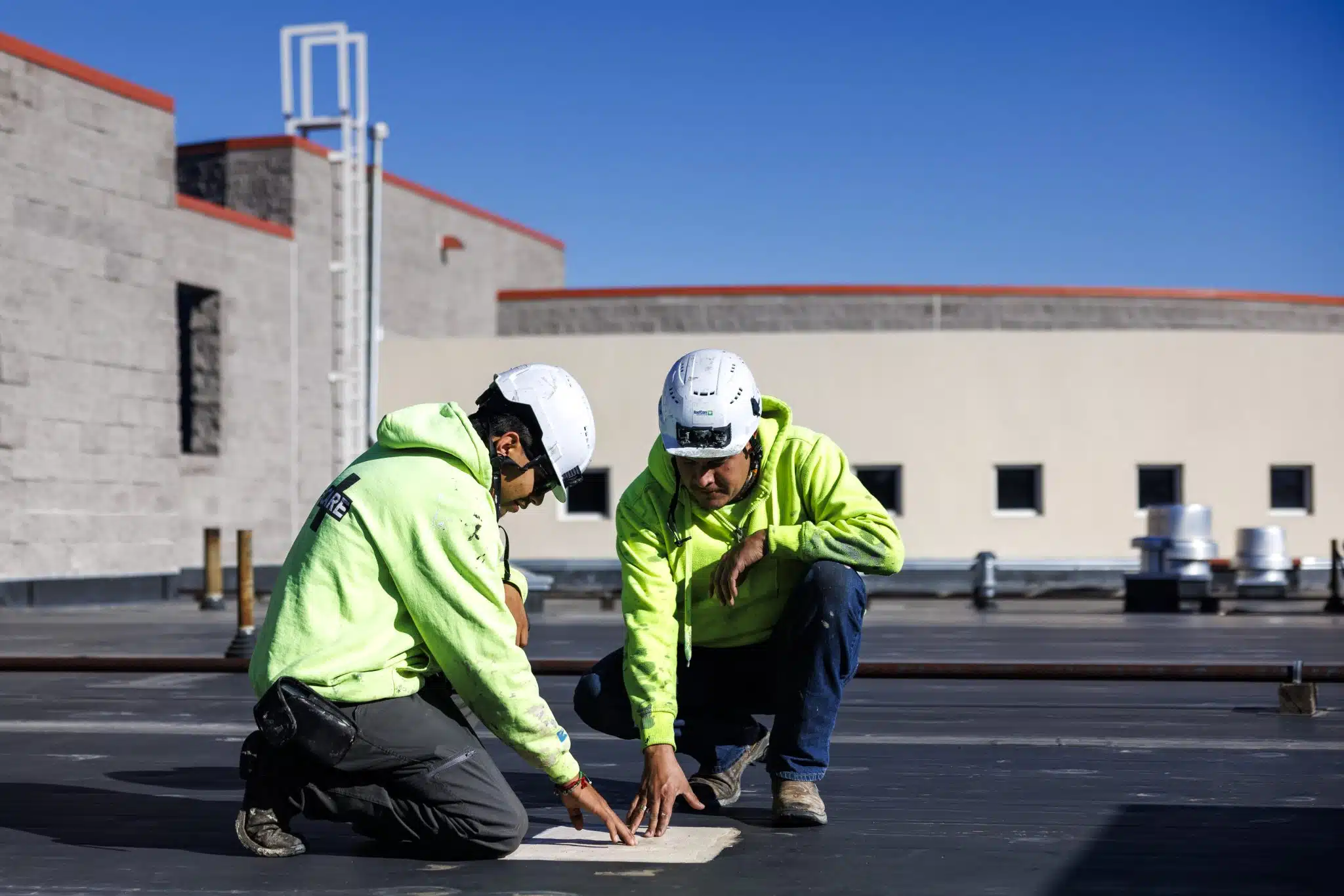
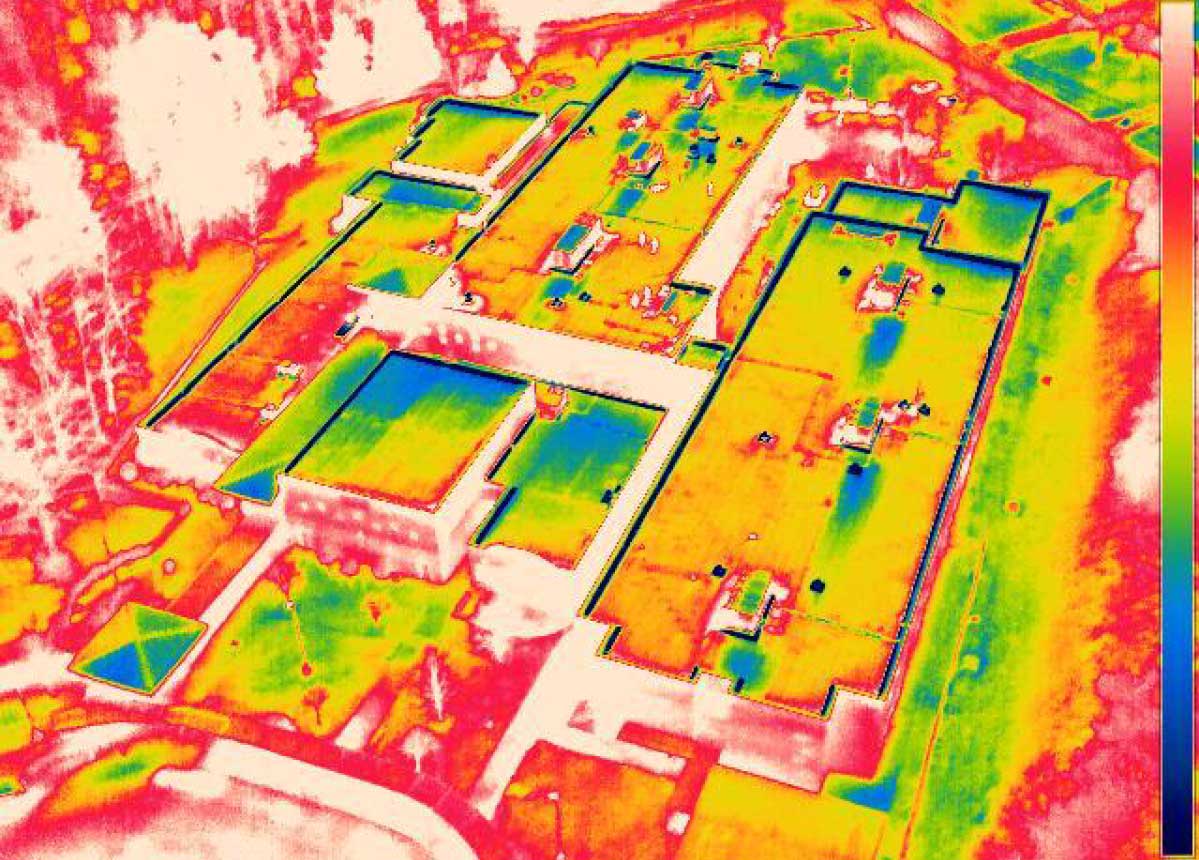
Thermal imaging identifies moisture intrusion in commercial roof assemblies that is invisible to visual inspection. Raleigh's humid subtropical climate and periodic hurricane rainfall events make infrared scanning a productive tool before any major roof capital decision.
Infrared roof scanning works on a simple physics principle: wet insulation stores heat during the day and releases it more slowly after sunset than dry insulation. When we scan a commercial roof with a thermal imaging camera one to three hours after sunset on a day that received direct solar gain, wet zones show as warmer areas in the thermal image against the cooler pattern of the dry field. The thermal pattern maps the moisture distribution beneath the membrane without cutting into it.
The technique has real utility in the Triangle's climate. Raleigh commercial buildings experience intense solar gain from May through September - which charges the thermal differential that makes the evening scan productive. The region's history of sustained hurricane remnant rainfall events, including Hurricane Florence in 2018 and Hurricane Helene's extended moisture period in 2024, means that insulation saturation from breached seams or compromised flashings is a realistic finding on buildings that have not been formally assessed since those events.
Infrared scanning is a screening tool, not a definitive moisture measurement. Every suspect zone identified by thermal imaging is confirmed with core sampling before we report it as confirmed wet insulation. The combination - thermal imaging for area-efficient screening, core sampling for ground-truth confirmation - produces a moisture map with defensible findings, not just a heat picture open to interpretation.
Survey Protocol: How We Conduct Infrared Scans on Raleigh Roofs
Scan timing is the most important variable in infrared roof survey quality. The roof surface needs to have received direct sun for at least four to six hours before the scan, and the scan needs to be conducted after the surface has begun to cool - typically one to three hours after sunset. Cloud cover during the solar gain period degrades the thermal differential and produces inconclusive results. In Raleigh's humid subtropical climate, afternoon convective cloud buildup is a scheduling variable we manage around - we schedule scans on days with clear afternoon forecasts and conduct them in the first two hours after sunset.
We scan in a systematic grid pattern, with the thermal camera positioned to eliminate reflective interference from rooftop equipment and mechanical units that retain heat independently of moisture. HVAC units, exhaust fans, and conduit runs all produce thermal signatures that can create false positives in an uncritical scan. We document equipment locations on the roof zone diagram before scanning and note thermal signatures from equipment in the scan report separately from membrane-related thermal anomalies.
For large commercial buildings - Research Triangle Park industrial facilities, NC State Centennial Campus research buildings, or the major warehouse developments along I-40 west toward Johnston County - infrared scanning covers the full roof field efficiently. Walking a 200,000 square foot roof to hand-place nuclear scanner readings at grid intervals takes substantially longer than covering the same area with thermal imaging. Infrared screening followed by targeted nuclear confirmation and core sampling is the most efficient protocol for large-footprint commercial buildings.
What Thermal Imaging Finds - and What It Does Not
Infrared scanning identifies the location and approximate extent of moisture accumulation in the insulation layer - it shows where the insulation is wet, which corresponds to where water entered the roof assembly. It does not identify the breach point that let the water in. A 50-square-foot wet insulation zone in the middle of the roof field may trace back to a seam failure in that zone, or it may trace back to a flashing failure at a penetration 30 feet away where water migrated laterally through the insulation before accumulating in the lowest point of the zone.
Finding the breach point requires follow-up investigation - visual inspection guided by the thermal map, core sampling to assess lateral migration patterns, and in some cases a flood test to confirm which surface feature is the active entry point. We include breach point investigation in our standard moisture survey scope when thermal scanning identifies wet zones.
Infrared scanning also does not measure the degree of insulation saturation - it identifies that moisture is present, not how much. A lightly damp zone and a fully saturated zone may produce similar thermal signatures depending on the time of night and atmospheric conditions. Core sampling confirms saturation level, which is the variable that drives the recover-vs-replace threshold analysis.
Applications in the Raleigh Market
Post-storm moisture assessment is the most frequent application for infrared scanning in Raleigh. After a significant rainfall event - the September 2024 Helene moisture period is the most recent reference - building owners who want to assess potential insulation damage without immediately committing to a full moisture survey can use thermal imaging as a first-pass screening. If the thermal scan is clean, the survey is completed quickly. If the scan identifies warm zones, the investigation proceeds to core sampling for confirmation.
Pre-acquisition due diligence is a second productive application. When evaluating a commercial building for acquisition in the active Wake County investment market, a thermal scan gives the buyer a broad moisture picture across the full roof field efficiently. The scan can be conducted in the evening of the same day as the physical inspection, adding minimal time to the due diligence schedule. Any warm zones identified in the scan are confirmed with cores before the due diligence period closes.
Pre-capital-decision scanning on aging roofs is a third application. A building owner considering whether to budget for a recover or a replacement in the coming fiscal year can use thermal scanning to establish the approximate extent of wet insulation before committing to a full moisture survey scope. If the thermal scan shows minimal warm zones, the recover option remains viable. If the thermal scan shows extensive warm zones across the field, the capital plan can be updated before the full survey is commissioned.
Frequently asked questions
What are the weather conditions needed for an infrared roof scan to be valid?
The roof surface needs four to six hours of direct solar gain during the day of the scan, and the scan needs to be conducted in the first two to three hours after sunset before the thermal differential between wet and dry insulation dissipates. Cloud cover during the afternoon solar gain period significantly degrades scan quality. We schedule Raleigh infrared surveys based on the day's actual solar gain - if the cloud cover during the day was extensive, we reschedule rather than conduct a scan that will not produce defensible findings.
How large of a roof area can infrared scanning cover in a single survey?
A single infrared scan crew working with modern thermal imaging equipment can cover 50,000 to 100,000 square feet in a two to three hour post-sunset window, depending on roof complexity. For larger buildings in the Research Triangle Park or I-40 industrial corridor, we deploy multiple camera operators to complete the scan within the valid thermal window. The usable scan window in Raleigh's climate is typically 90 minutes to 2.5 hours after sunset - once the surface has cooled below the threshold for productive thermal differential, the scan data quality degrades.
Can infrared scanning replace core sampling?
No. Infrared scanning identifies suspect zones - areas where thermal patterns are consistent with wet insulation. Core sampling confirms whether the suspected zone is actually wet, and if so, how wet. Reporting infrared findings without core confirmation introduces too much uncertainty for capital decisions - a thermal pattern that suggests 20% of the roof area is wet might resolve to 8% confirmed saturation on core sampling, or it might confirm 25%. That difference determines whether the recommendation is recover or replace. We do not produce recover-vs-replace recommendations based on thermal imaging alone.