Where Standing Seam Makes Sense in the Triangle
Steep-slope institutional and campus buildings: NC State's main campus on Western Boulevard, Duke University's West Campus in Durham, UNC Chapel Hill's central academic core, and the private school campuses in Cary, Apex, and North Raleigh have significant inventories of institutional buildings where standing seam is architecturally appropriate, durable enough to match the building's intended lifecycle, and compatible with existing campus materials. Many of these buildings have aging corrugated or 5-V crimp metal roofs that are at end of serviceable life and qualify for standing seam replacement without full structural modification. Institutional procurement for these projects runs through university facilities management, which we have experience working with on NC State and Duke campus work.
Historic buildings in Downtown Raleigh and preservation districts: The City of Raleigh's historic overlay districts - Moore Square, Oakwood, Boylan Heights, and the Downtown Historic District centered around City Market and Fayetteville Street - carry design standards administered by the Raleigh Historic Development Commission. When those standards require metal roofing and prohibit synthetic membrane substitutes, standing seam is typically the specified system. We have coordinated standing seam projects through the RHDC's Certificate of Appropriateness process and understand the submittal requirements.
Long-hold industrial buildings along the outer I-540 and US-1 corridors: The industrial and logistics development pushing out along the western I-540 outer loop, the US-1 South corridor toward Fuquay-Varina, and the I-40 East corridor toward Clayton includes a growing inventory of large-footprint warehouse and distribution buildings where institutional owners with 40-year holds are specifying standing seam on steep-slope sections to eliminate reroof cycles from the capital budget. The calculation works when the structural system supports the panel weight and the ownership horizon exceeds 25 years.
Corporate campus buildings on Research Triangle Park: RTP facilities - particularly the older owner-occupied buildings on the park's interior roads between the NC 54 and NC 55 corridors - often have steep-slope or mansard roofing elements on otherwise flat-roof buildings. These elements are strong standing seam candidates because the ownership tenure on RTP campus buildings tends to be long and the buildings carry corporate image requirements that favor durable, low-maintenance roofing materials over periodic reroofing.
Panel and Attachment Specifications for Triangle Conditions
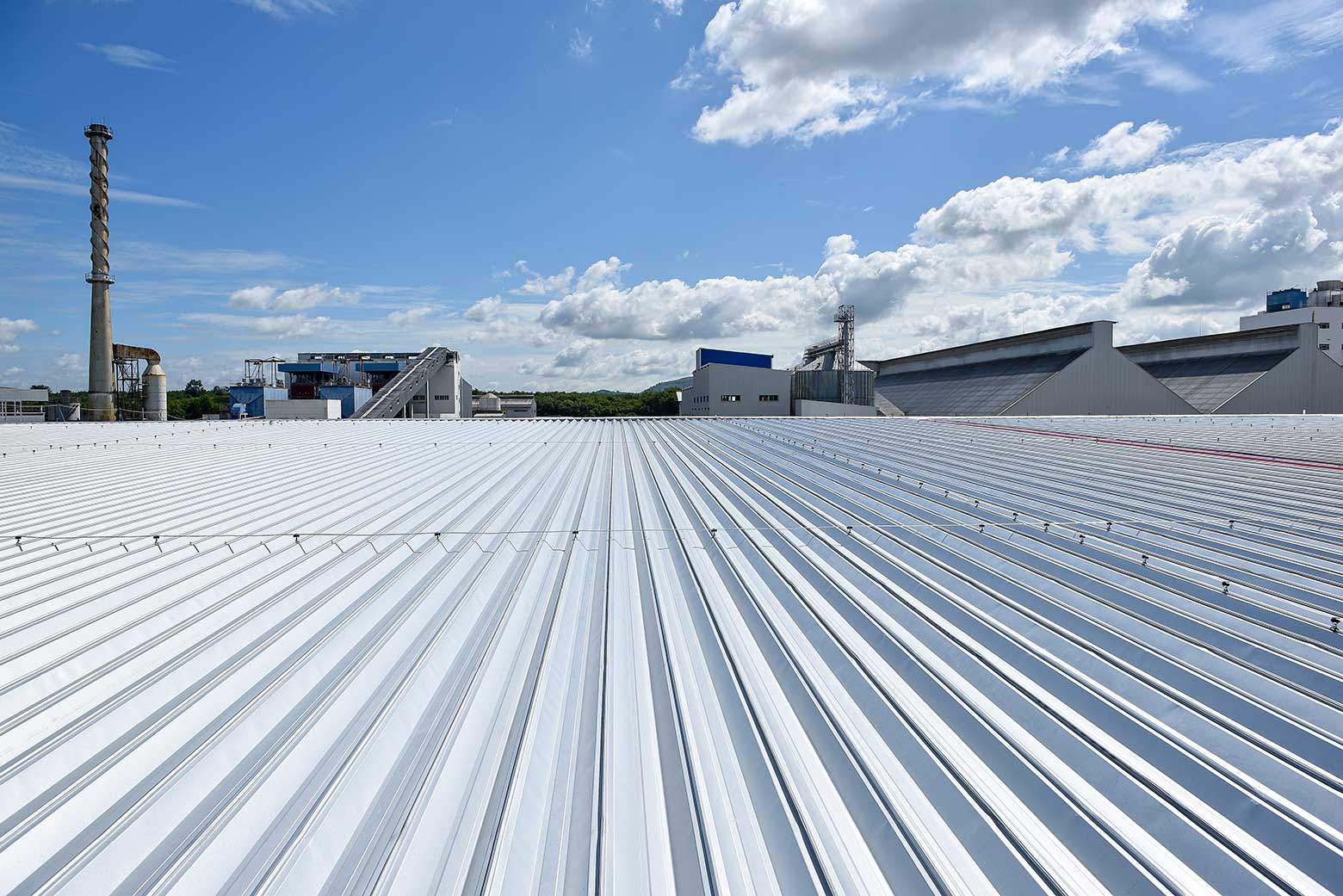
Panel material: Galvalume steel with Kynar 500 / PVDF coating is our standard commercial specification for the Raleigh market. PVDF-coated panels carry 30-to-40-year manufacturer paint warranties and resist the UV-driven chalking and color shift that would otherwise require refinishing. The Triangle's summer UV intensity - amplified by Raleigh's relatively open terrain compared to the more sheltered urban cores of Charlotte or Atlanta - makes the PVDF coating's UV stability a meaningful performance advantage over lower-grade finishes. Aluminum is specified for buildings in the RTP chemical corridor or any application with industrial exhaust or elevated atmospheric corrosive exposure. Copper is used exclusively on historic district projects where the preservation standard or the architectural context requires it.
Panel width and seam height: 16-inch panels with 1.5-inch or 2-inch seams are the most common configuration for Raleigh commercial standing seam applications. Wider panels are specified on lower-slope applications where thermal expansion movement over long panel runs requires longer floating clips. Taller seams improve water-shedding capacity on applications approaching the 1:12 minimum slope - relevant for the many Raleigh institutional buildings with slope constraints driven by their original design.
Clip system: Floating clips are standard on all Raleigh commercial standing seam applications where panel runs exceed 20 feet. The Triangle's thermal cycle produces linear expansion in steel panels of roughly 0.5 to 0.75 inches per 30-foot panel run across the annual temperature range. Fixed clips on long panel runs will buckle the panel or pull through the clip over time - a failure mode we see on aging corrugated metal installations on older RTP buildings where the original installation used fixed attachment on panel runs that the thermal cycle eventually stressed to failure.
Underlayment: Self-adhered modified bitumen underlayment under all Raleigh commercial standing seam installations. The Triangle's high summer humidity means vapor-permeable underlayment that is also waterproof is not a premium specification - it is the minimum responsible approach for a region that regularly experiences the kind of construction-schedule weather events that leave roofs partially covered overnight during installation.
Permitting and Structural Coordination in Raleigh
Structural assessment: Standing seam panel assemblies run 1.5 to 3 pounds per square foot depending on gauge, material, and insulation assembly below. Before any standing seam specification is finalized, we require written confirmation from a structural engineer that the building's roof framing carries the panel weight plus any code-required snow or ice load. The January 2022 ice storm that shut down the Triangle for several days is the relevant calibration event - ice accumulation on existing roof systems caused structural failures on buildings where the load was not anticipated in the original design.
City of Raleigh and Triangle-area permitting: Standing seam installation requires a building permit from the relevant municipality - City of Raleigh, Town of Cary, City of Durham, Town of Chapel Hill, City of Garner, or Wake County for unincorporated areas. For projects in Raleigh's historic overlay districts, a Certificate of Appropriateness from the RHDC must be obtained before permit submission. We manage both processes as part of pre-construction and have established contacts in the City of Raleigh's commercial permitting office on the ground floor of One Exchange Plaza.
Crane and access logistics: Panel installation on tall or steep-slope commercial buildings requires crane lifts for material delivery. Downtown Raleigh crane positioning requires coordination with the City of Raleigh's Right-of-Way office for any crane that encroaches on a public street. Fayetteville Street, Wilmington Street, and the pedestrian-heavy blocks adjacent to Moore Square require early morning scheduling and coordination with City Plaza event calendars. We build crane permit lead time into the pre-construction schedule - typically 10 to 15 business days for City of Raleigh right-of-way permits.
Frequently asked questions
What minimum slope is required for standing seam on a Raleigh commercial building?
1:12 minimum for standard standing seam systems. Below that pitch, you are in low-slope single-ply territory and drainage relies on drain capacity rather than gravity. Raleigh's thunderstorm surge events - the Triangle can receive 3 to 5 inches in an afternoon - make the 1:12 minimum a hard floor. We have documented ponding failures on standing seam at marginal slope on Triangle buildings where the original installer did not account for the roof's actual drainage pattern.
How does standing seam perform through Raleigh's ice storm cycle?
Standing seam performs well in the Triangle's periodic winter ice events - the January porous insulation or ponded-water systems do. The floating clip system accommodates the thermal contraction during ice formation and expansion during thaw without clip pullout or panel distortion, provided the structural system was sized for the load.
Can standing seam be installed over an existing roof on a Raleigh commercial building?
Over dry insulation on a structurally sound deck, yes - if the structural assessment confirms adequate load capacity for the added weight. Recovery over wet insulation is not acceptable for any system. For steep-slope applications over existing corrugated or 5-V crimp metal - common on older RTP campus buildings - recovery is standard where the deck and framing are sound and local code permits it.
What warranty does standing seam metal carry?
PVDF-coated Galvalume steel carries 30-to-40-year manufacturer paint warranties against chalking and fading. Structural integrity warranties from panel manufacturers run 20 to 30 years depending on gauge and exposure category. Contractor workmanship warranty terms are set at engagement. For NC State, Duke, and UNC institutional owners managing buildings on 50-year-plus horizons, the combined warranty stack on standing seam often represents better total cost of ownership than two 20-year membrane replacement cycles.