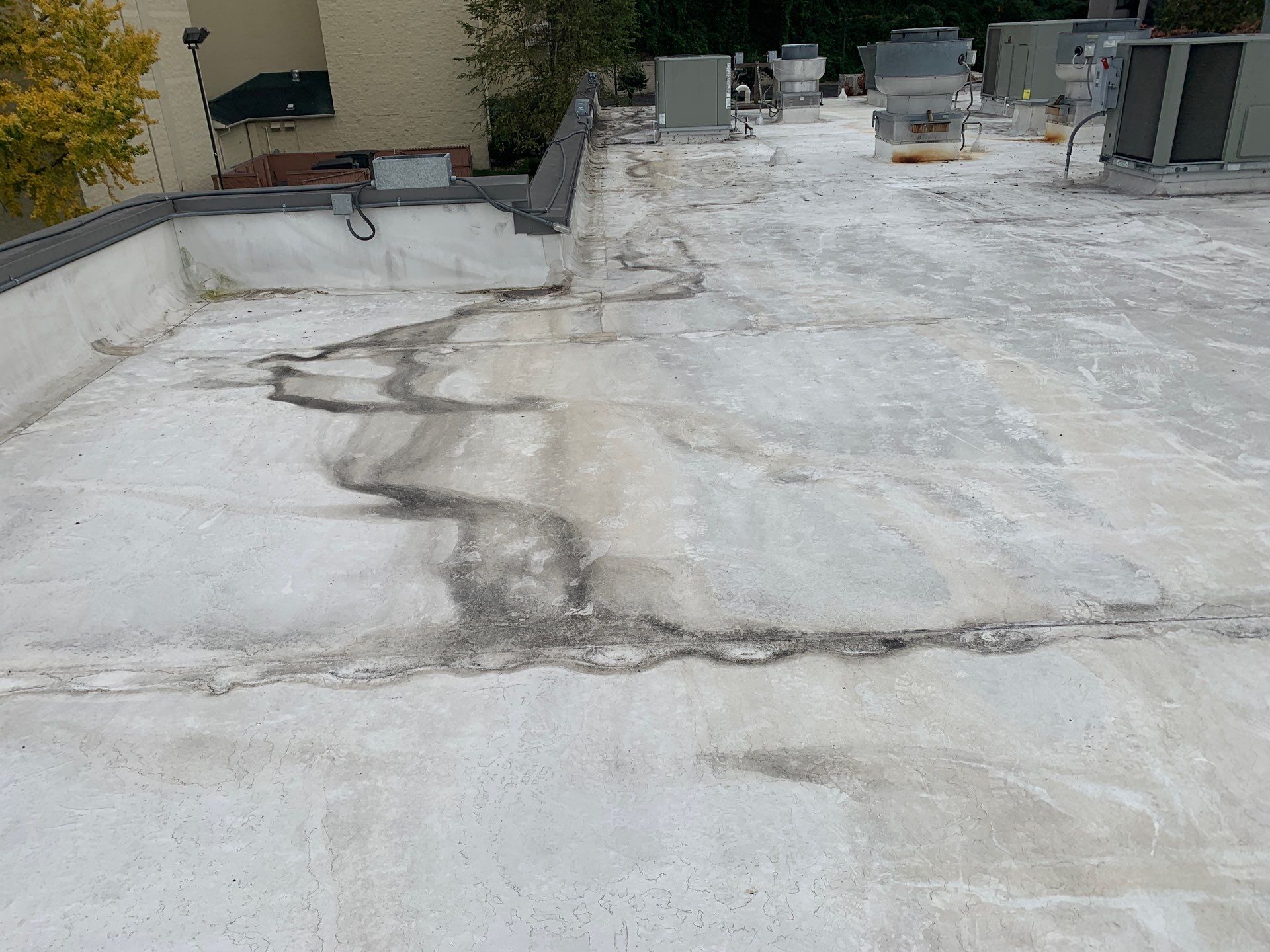
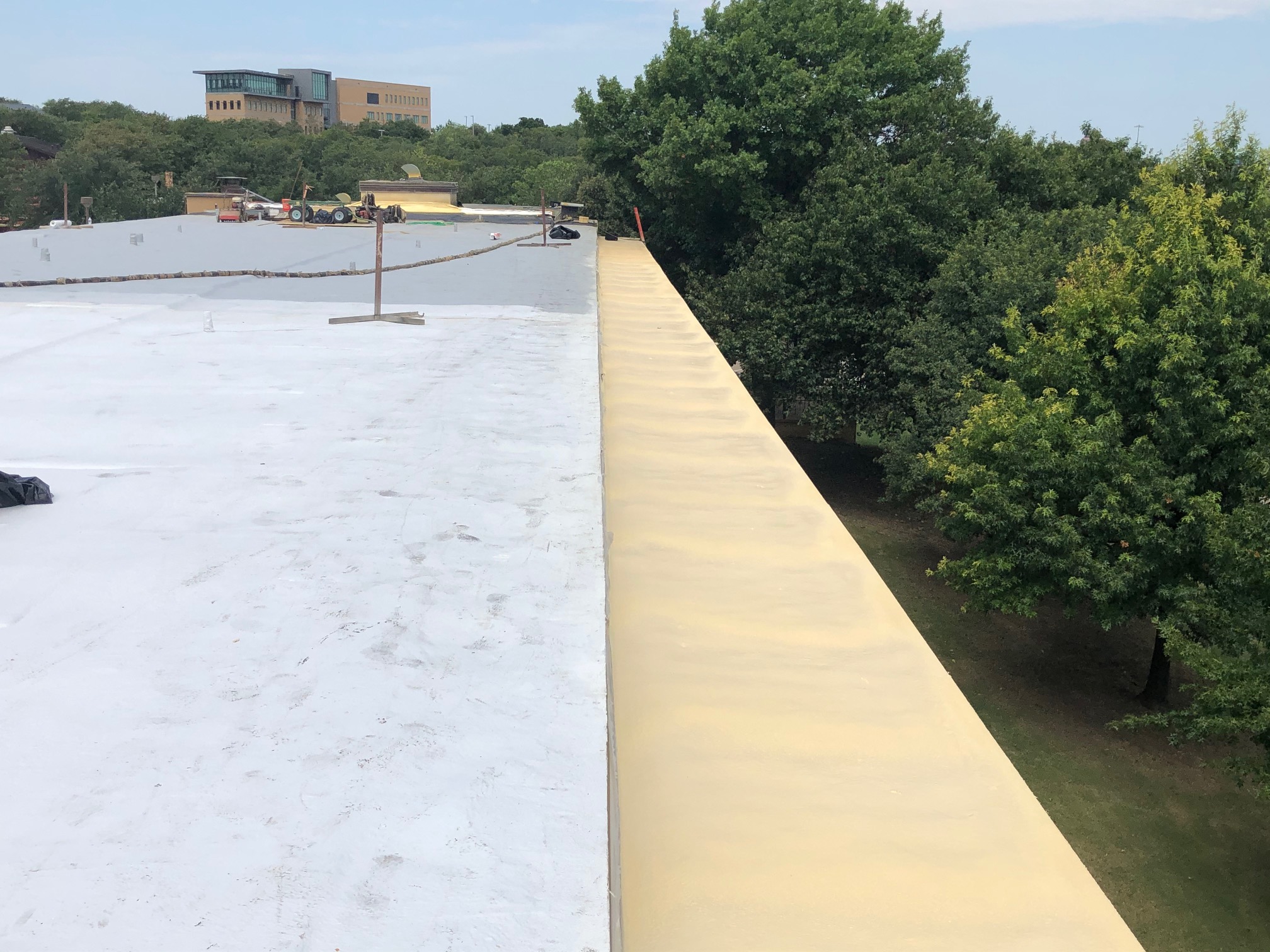
Raleigh sits on the inland path that hurricane remnants and tropical systems regularly follow once they move off the Carolina coast, and the Piedmont's severe thunderstorm season adds straight-line wind and downburst events on top of that seasonal risk. Both produce a similar signature on commercial low-slope roofs: lifted or torn membrane at the perimeter and at rooftop equipment curbs, displaced flashing, and, on properties near tree lines, debris punctures from broken limbs and downed branches.
Wind damage on a TPO, EPDM, or modified bitumen roof usually starts at the edge. Perimeter metal, parapet flashing, and equipment curbs are the first places sustained wind uplift finds a weak lap or an under-fastened seam, and once wind gets underneath the membrane at one of those points, it can travel and lift a much larger section than the initial failure point suggests. We document the full extent of that lifted or torn area, beyond the visible tear itself, because uplift damage frequently continues past what's obvious from the ground or from a single rooftop photo.
Pine and hardwood debris punctures are a distinct wind-damage category in Raleigh and the wider Triangle, where mature tree cover borders many older commercial properties and even some of the newer logistics and warehouse construction along the I-40 and I-540 growth corridors. A branch puncture reads as a point failure on an otherwise sound membrane, and the claim documentation needs to identify it as storm-caused impact damage — distinct from wind-uplift failure — since the repair scope and the carrier's cause-of-loss coding differ between the two.
Severe thunderstorm outflow and downburst winds move fast and hit narrow paths, which means storm damage across a single property, or across neighboring buildings in the same business park, can vary significantly from one roof section to the next. Our assessment maps damage by roof section and elevation rather than reporting a single overall condition, so the documentation reflects where the wind actually did the work and where it didn't.
We photograph every affected section with reference to a roof plan, measure the extent of displaced or torn membrane, and identify the point of origin where uplift began. Where a puncture or tear has allowed water into the building, we note the interior moisture path as part of the same report, since interior damage is frequently a separate line item in a wind claim and needs its own documentation trail.
We're your roofing contractor, not a public adjuster — our role is producing the damage assessment and meeting the adjuster on the roof, not filing or negotiating the claim on your behalf. If a joint roof walk is scheduled, we're there to point directly to documented damage and answer technical questions about the membrane, fastening, and failure pattern.
Property type changes what a wind assessment needs to capture. A Research Triangle Park office or lab building typically carries rooftop mechanical equipment, dense penetrations, and screening walls that create additional wind-catching surfaces and additional places for uplift to start; a big-box warehouse along I-40 or I-540 has fewer penetrations but a much larger unbroken membrane field, where a single edge failure can propagate across a long run before it's noticed. Our assessment approach adjusts to which of those roof types is involved rather than applying a generic checklist to both.
Storm timing also affects the assessment. A wind event that hits during business hours on an occupied multi-tenant building often gets reported and inspected quickly; an overnight or weekend event on a warehouse or distribution property can go unnoticed for days, during which continued exposure through a torn or lifted section compounds the original damage. When there's a gap between the storm date and the inspection, we document what's consistent with the original wind event versus what accumulated afterward, since carriers look closely at that distinction on delayed-report claims.
Wind & Storm Claim Questions
What does wind damage look like on a commercial flat roof?
Wind damage on a low-slope commercial roof typically appears as lifted or torn membrane at the perimeter, parapets, and rooftop equipment curbs, displaced or missing edge metal, and open seams where wind got underneath the membrane. It's not always visible from ground level, which is why a full roof walk is part of every wind-damage assessment.
Are hurricane remnant storms in Raleigh covered under a standard commercial policy?
Coverage depends on your specific policy — most commercial property policies cover wind damage from named storms and their remnants, though some carry separate wind or named-storm deductibles. We document the damage; your policy language and adjuster determine how the claim is coded and covered.
How do you tell wind damage apart from an installation defect?
Storm-related wind failure typically shows a clear point of origin — a lifted seam or damaged fastener at the edge where uplift began — with a displacement pattern that spreads outward from that point. An installation defect tends to show a consistent weak point unrelated to wind direction. We document fastening pattern and failure geometry so that distinction is clear in the assessment.
What if only part of my building's roof shows wind damage?
We map and document damage section by section rather than reporting a single roof-wide condition. If only part of the roof shows wind damage, the assessment identifies exactly which sections and elevations are affected, which keeps the claim scoped to the actual loss.
Can debris punctures from a storm be claimed separately from wind-lift damage?
Yes. A debris puncture is a distinct failure mode from wind-uplift membrane damage, even when both occur during the same storm event, and we document them separately in the assessment so each is scoped and coded correctly.